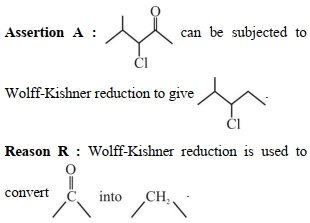
- ABoth $A$ and $R$ are true but $R$ is NOT the correct explanation of $A$.
- B$A$ is true but $R$ is false.
- ✓$A$ is false but $R$ is true.
- DBoth $A$ and $R$ are true and $R$ is the correct explanation of $A.$
Generate a complete, print-ready paper with questions like this in minutes — across 16+ boards, with answer keys.
(Assume $100\%$ ionization)
$A.$ $0.500\,M\,C _2 H _5 OH ( aq )$ and $0.25\, M\, KBr ( aq )$
$B.$ $0.100\,M\,K _4\left[ Fe ( CN )_6\right]$ (aq) and $0.100\, M$ $FeSO _4\left( NH _4\right)_2 SO _4$ (aq)
$C.$ $0.05 \,M\, K _4\left[ Fe ( CN )_6\right]( aq )$ and $0.25\, M\, NaCl$ (aq)
$D.$ $0.15\, M\, NaCl ( aq )$ and $0.1\, M BaCl _2$ (aq)
$E.$ $0.02\, M\, KCl\, MgCl _{2 .} 6 H _2 O ( aq )$ and $0.05\, M$ $KCl ( aq )$
Assertion $(A)$ : Haloalkanes react with $\mathrm{KCN}$ to form alkyl cyanides as a main product while with $\mathrm{AgCN}$ form isocyanide as the main product.
Reason $(R)$ : $\mathrm{KCN}$ and $\mathrm{AgCN}$ both are highly ionic compounds.
In the light of the above statement, choose the most appropriate answer from the options given below: