MCQ
Given below are two statements: one is labelled as Assertion $A$ and the other is labelled as Reason $R$.

Assertion $A$ : Body $'P'$ having mass $M$ moving with speed $'u'$ has head-on collision elastically with another body $'Q'$ having mass $'m'$ initially at rest. If $m< < M,$ body $'Q'$ will have a maximum speed equal to $'2u'$ after collision.

Reason $R$ : During elastic collision, the momentum and kinetic energy are both conserved.

In the light of the above statements, choose the most appropriate answer from the options given below:

  • A
    $A$ is not correct but $R$ is correct.
  • B
    Both $A$ and $R$ are correct but $R$ is $NOT$ the correct explanation of $A$.
  • Both $A$ and $R$ are correct and $R$ is the correct explanation of $A$.
  • D
    $A$ is correct but $R$ is not correct.
Answer

Correct option: C.
Both $A$ and $R$ are correct and $R$ is the correct explanation of $A$.
c
For $e =1$ and second body at rest

$V_{2}=\frac{2 m_{1} u_{1}}{m_{1}+m_{2}}=\frac{2 u(M)}{M+m} \simeq 2 u$

Since $M > >m$

Need a full question paper?

Generate a complete, print-ready paper with questions like this in minutes — across 16+ boards, with answer keys.

Start Generating Free

Similar questions

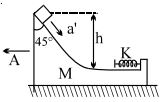
$A$ small block of mass $m$ is placed on $a$ wedge of mass $M$ as shown, which is initially at rest. All the surfaces are frictionless . The spring attached to the other end of wedge has force constant $k$. If $a'$ is the acceleration of $m$ relative to the wedge as it starts coming down and $A$ is the acceleration acquired by the wedge as the block starts coming down, then 
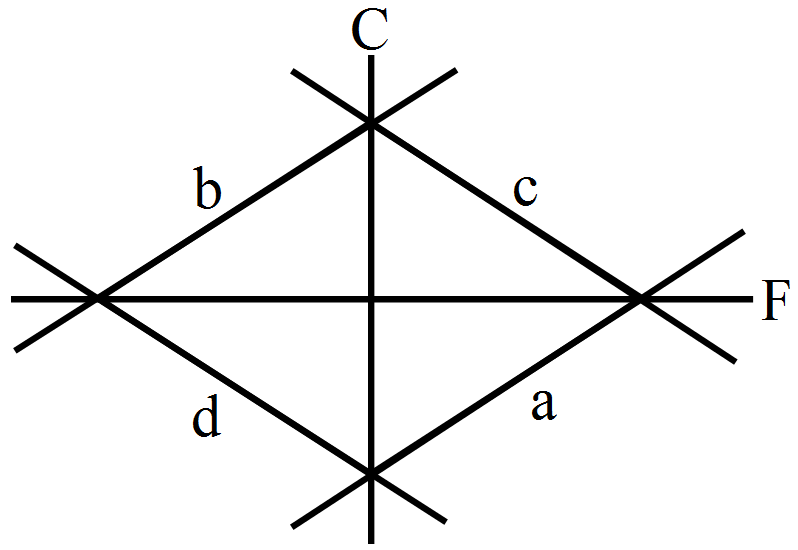
Four light waves are represented by

  1. $\text{y}=\text{a}_1\sin\omega\text{t}$

  2. $\text{y}=\text{a}_2\sin(\omega\text{t}+\in)$

  3. $\text{y}=\text{a}_1\sin2\omega\text{t}$

  4. $\text{y}=\text{a}_2\sin2(\omega\text{t}+\in)$

Interference fringes may be observed due to superposition of:

  1. (i) and (ii)
  2. (i) and (iii)
  3. (ii) and (iv)
  4. (iii) and (iv)
The rise of a liquid in a capillary tube depends on
  1. The material.
  2. The length.
  3. The outer radius.
  4. The inner radius of the tube.
In a radioactive decay, neither the atomic number nor the mass number changes. Which of the following particles is emitted in the decay?
  1. Proton.
  2. Neutron.
  3. Electron.
  4. Photon.
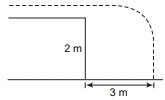
Water is flowing from a horizontal pipe fixed at a height of $2\,m$ from the ground. If it falls at a horizontal distance of $3\,m$ as shown in figure, the speed of water when it leaves the pipe is $............\,ms^{-1}$ (take $g=9.8\,ms ^{-2}$ )
An object kept in a large room having air temperature of $25^{\circ} \mathrm{C}$ takes $12$ minutes to cool from $80^{\circ} \mathrm{C}$ to $70^{\circ} \mathrm{C}$. The time taken to cool for the same object from $70^{\circ} \mathrm{C}$ to $60^{\circ} \mathrm{C}$ would be nearly.....$min$
Which of the curves in figure represents the relation between Celsius and Fahrenheit temperatures.

A diatomic ideal gas is compressed adiabatically to $\frac{1}{32}$ of its initial volume. If the initial temperature of the gas is $T_1$ (in Kelvin) and the final temperature is $a T_1$, the value of $a$ is
A boy pushes a box of mass $2\, kg$ with a force $\overrightarrow{ F }=(20 \hat{ i }+10 \hat{ j }) N$ on a frictionless surface. If the box was initially at rest, then ...........  $m$ is displacement along the $x-$axis after $10\, s$.
A truck moving on horizontal road towards east with velocity $20\, ms^{-1}$ collides elastically with a light ball moving with velocity $25\, ms^{-1}$ along west. The velocity of the ball just after collision