MCQ
Given below are two statements: one is labelled as Assertion$(A)$ and the other is labelled as Reason $(R).$

$Assertion$ $(A)$ : In Vernier calliper if positive zero error exists, then while taking measurements, the reading taken will be more than the actual reading.

$Reason$ $(R)$ : The zero error in Vernier Calliper might have happened due to manufacturing defect or due to rough handling.

In the light of the above statements, choose the correct answer from the options given below :

  • A
     Both $(A)$ and $(R)$ are correct and $(R)$ is the correct explanation of $(A)$
  • Both $(A)$ and $(R)$ are correct but $(R)$ is not the correct explanation of $(A)$
  • C
     $(A)$ is true but $(R)$ is false
  • D
    $(A)$ is false but $(R)$ is true

Answer

Correct option: B.
Both $(A)$ and $(R)$ are correct but $(R)$ is not the correct explanation of $(A)$
b
Assertion Reason both are correct Theory

Need a full question paper?

Generate a complete, print-ready paper with questions like this in minutes — across 16+ boards, with answer keys.

Start Generating Free

Similar questions

A particle of mass $'{m}'$ is moving in time $'t'$ on a trajectory given by

$\overrightarrow{{r}}=10 \alpha {t}^{2}\, \hat{{i}}+5 \beta({t}-5)\, \hat{{j}}$

Where $\alpha$ and $\beta$ are dimensional constants. The angular momentum of the particle becomes the same as it was for ${t}=0$ at time ${t}=$ .....$seconds.$

When we cool a gas below its condensation point, the K.E. of its molecules:
The gravitational potential energy of a system consisting of two particles separated by a distance r is:
$Assertion :$ In an isolated system the entropy increases.
$Reason :$ The processes in an isolated system are adiabatic.
A ball is thrown vertically upwards from the ground $G$ with a speed $u$. It reaches a point $B$ at a height $h$ (lower than the maximum height) after time $t_1$. It returns to the ground after time $t_2$ from the instant it was at $B$ during the upward journey. Then $t_1t_2$ is equal to
Two bodies A and B of equal mass are suspended from two separate massless springs of spring constant k1 and k2 respectively. If the bodies oscillate vertically such that their maximum velocities are equal, the ratio of the amplitude of A to that of B is:

  1. $\frac{\text{k}_1}{\text{k}_2}$

  2. $\sqrt{\frac{\text{k}_1}{\text{k}_2}}$

  3. $\frac{\text{k}_2}{\text{k}_1}$

  4. $\sqrt{\frac{\text{k}_2}{\text{k}^1}}$

If on heating liquid through $80°C$, the mass expelled is $(1/100)^{th}$ of mass still remaining, the coefficient of apparent expansion of liquid is
The magnetic moment has dimensions of
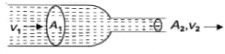
A liquid flows in the tube from left to right as shown in figure. $A_1$ and $A_2$ are the cross-sections of the portions of the tube as shown. The ratio of speed $\frac{v_1}{v_2}$ will be .......... 
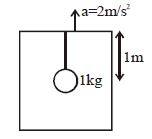
In the figure shown a mass $1\  kg$ is connected to a string of mass per unit length $1.2\  gm/m$ . Length of string is $1\  m$ and its other end is connected to the top of a ceiling which is accelerating up with an acceleration $2\  m/s^2$ . A transverse pulse is produced at the lowest point of string. Time taken by pulse to reach the top of string is .... $s$