MCQ
Given below are two statements :
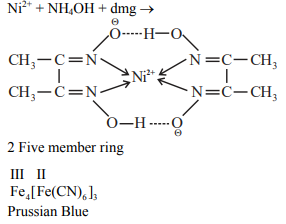
Statement (I) : Dimethyl glyoxime forms a sixmembered covalent chelate when treated with $NiCl _2$ solution in presence of $NH _4 OH$.
Statement (II) : Prussian blue precipitate contains iron both in $(+2)$ and $(+3)$ oxidation states. In the light of the above statements, choose the most appropriate answer from the options given below:
  • Statement I is false but Statement II is true
  • B
    Both Statement I and Statement II are true
  • C
    Both Statement I and Statement II are false
  • D
    Statement I is true but Statement II is false
Answer

Correct option: A.
Statement I is false but Statement II is true
(A)
Image

Need a full question paper?

Generate a complete, print-ready paper with questions like this in minutes — across 16+ boards, with answer keys.

Start Generating Free

Similar questions

A distinctive and characteristic functional group of fats is
On adding solid potassium cyanide to water
Which of the following elements will have the lowest electron affinity
Adding inert gas to system

${N_{2(g)}} + 3{H_{2(g)}} \rightleftharpoons \,2N{H_{3(g)}}$ at equilibrium at constant volume will lead to

Assertion : Carbanions like ammonia have pyramidal shape.

Reason : The carbon atom carrying negative charge has an octet of electrons.

Given below are two statements :
Statement I: Group 13 trivalent halides get easily hydrolyzed by water due to their covalent nature.
Statement II: $AlCl _3$ upon hydrolysis in acidified aqueous solution forms octahedral $\left[ Al \left( H _2 O \right)_6\right]^{3+}$ ion.
In the light of the above statements, choose the correct answer from the options given below : 
Which of the following statements about benzyl chloride is incorrect
At $25^{\circ} C$, the molar conductance at infinite dilution for the strong electrolytes $NaOH ,$ $NaCl$ and $BaCl _{2}$ are $248 \times 10^{-4}, 126 \times 10^{-4}$ and $280 \times 10^{-4} \,Sm ^{2} mol ^{-1}$ respectively. $\lambda_{m}^{o} B a(O H)_{2}$ in $S m^{2} m o l^{-1}$ is


Major product $(Q)$ of following reaction is :
The number of species from the following in which the central atom uses $\mathrm{sp}^3$ hybrid orbitals in its bonding is_______.

$\mathrm{NH}_3, \mathrm{SO}_2, \mathrm{SiO}_2, \mathrm{BeCl}_2, \mathrm{CO}_2, \mathrm{H}_2 \mathrm{O}, \mathrm{CH}_4, \mathrm{BF}_3$