MCQ
Given below are two statements:

Statement $(I)$ : $\mathrm{SiO}_2$ and $\mathrm{GeO}_2$ are acidic while $\mathrm{SnO}$ and $\mathrm{PbO}$ are amphoteric in nature.

Statement $(II)$ : Allotropic forms of carbon are due to property of catenation and $\mathrm{p} \pi-\mathrm{d} \pi$ bond formation.

In the light of the above statements, choose the most appropriate answer from the options given below:

  • A
    Both Statement $I$ and Statement $II$ are false
  • B
    Both Statement $I$ and Statement $II$ are true
  • Statement $I$ is true but Statement $II$ is false
  • D
    Statement $I$ is false but Statement $II$ is true
Answer

Correct option: C.
Statement $I$ is true but Statement $II$ is false
c
$\mathrm{SiO}_2$ and $\mathrm{GeO}_2$ are acidic and $\mathrm{SnO}, \mathrm{PbO}$ are amphoteric.

Carbon does not have d-orbitals so can not form $\mathrm{p} \pi-\mathrm{d} \pi$ Bond with itself. Due to properties of catenation and $\mathrm{p} \pi-\mathrm{p} \pi$ bond formation. carbon is able to show allotropic forms.

Need a full question paper?

Generate a complete, print-ready paper with questions like this in minutes — across 16+ boards, with answer keys.

Start Generating Free

Similar questions

The total energy of the electron of $H-$ atom in the second quantum state is $-E_2$ . The total energy of the $He^+$ atom in the third quantum state is
The standard enthalpy of combustion at $25\,^oC$ of hydrogen, cyclohexene $(C_6H_{10})$ and cyclohexane $(C_6H_{12})$ are $-241, -3800$ and $-3920\, kJ/mole$ respectively. Calculate the heat of hydrogenation of cyclohexene........$kJ/mol$
Second ionization potential of $Li, Be$ and $B$ is in the order
In given some reaction correct product match will be

$(a)\,N{H_4}N{O_2}\xrightarrow{\Delta }{N_2} + {H_2}O$

$(b)\,N{H_4}N{O_3}\xrightarrow{\Delta }{N_2}O + {H_2}O$

$(c)\,N{a_2}C{O_3}\xrightarrow{\Delta }N{a_2}O + C{O_2}$

$(d)\,N{H_4}Cl\xrightarrow{\Delta }N{H_3} + HCl$

A compound of carbon hydrogen and nitrogen contains three elements in the respective ratio of $9 : 1 : 35$ grams. The Empirical formula for the compound is
The third ionization energy is maximum for
If $\left[ Cu \left( H _{2} O \right)_{4}\right]^{2+}$ absorbs a light of wavelength $600$ $nm$ for $d - d$ transition, then the value of octahedral crystal field splitting energy for $\left[ Cu \left( H _{2} O \right)_{6}\right]^{2+}$ will be $.....\,\times 10^{-21}\, J$. (Nearest Integer)

(Given : $h =6.63 \times 10^{-34} \,Js$ and $c =3.08 \times 10^{8} \,ms ^{-1}$ )

$\mathop {\boxed{{C_4}{H_9}Cl}}\limits_{Optically\,Active}^{Compound\,A} \xrightarrow[{DMSO}]{{NaCN}}$ $[R]-2-$ methyl   Butane Nitrile ; Identify compound $'A'$ ?
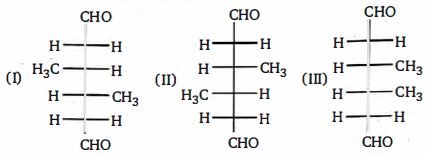
Which of the following statements best describes the stereochemical relationships  of compound $I, II$ and $III$ shown below ?
The option(s) with only amphoteric oxides is(are)

$[A]$ $\mathrm{Cr}_2 \mathrm{O}_3, \mathrm{BeO}, \mathrm{SnO}, \mathrm{SnO}_2$

$[B]$ $\mathrm{Cr}_2 \mathrm{O}_3, \mathrm{CrO}, \mathrm{SnO}, \mathrm{PbO}$

$[C]$ $\mathrm{NO}, \mathrm{B}_2 \mathrm{O}_3, \mathrm{PbO}, \mathrm{SnO}_2$

$[D]$ $\mathrm{ZnO}, \mathrm{Al}_2 \mathrm{O}_3, \mathrm{PbO}, \mathrm{PbO}_2$