MCQ
Given below are two statements :

Statement $I$ : The contact angle between a solid and a liquid is a property of the material of the solid and liquid as well.

Statement $II$ : The rise of a liquid in a capillary tube does not depend on the inner radius of the tube.

In the light of the above statements, choose the correct answer from the options given below :

  • A
    Both Statement $I$and Statement $II$ are false
  • B
    Statement $I$ is false but Statement $II$ is true.
  • Statement $I$ is true but Statement $II$ is false.
  • D
    Both Statement $I$ and Statement $II$ are true.
Answer

Correct option: C.
Statement $I$ is true but Statement $II$ is false.
c
Statement $I$ is correct as we know contact angle depends on cohesine and adhesive forces.

Statement $II$ is incorrect because height of liquid is given by $h==\frac{2 T \cos \theta_C}{\rho g r}$ where $r$ is radius of

Tube (assuming length of capillary is sufficient) Hence option $(3)$ is correct.

Need a full question paper?

Generate a complete, print-ready paper with questions like this in minutes — across 16+ boards, with answer keys.

Start Generating Free

Similar questions

Which of the following statements are correct.
A body of mass $m $ is attached to the lower end of a spring whose upper end is fixed. The spring has negligible mass. When the mass $m$ is slightly pulled down and released , it oscillates with a time period of $3\,s$ . When the mass $m$ is increased by $1\,kg$ , the time period of oscillations becomes $5\,s$ . The value of $m$ in $kg$ is
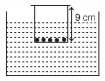
A wide bottom cylindrical massless plastic container of height $9 \,cm$ has $40$ identical coins inside it and is floating on water with $3 \,cm$ inside the water. If we start putting more of such coins on its lid, it is observed that after $N$ coins are put, its equilibrium changes from stable to unstable. Equilibrium in floating is stable if the geometric centre of the submerged portion is above the centre of the mass of the object). The value of $N$ is closed to
Young's modulus is determined by the equation given by $\mathrm{Y}=49000 \frac{\mathrm{m}}{\ell} \frac{\text { dyne }}{\mathrm{cm}^2}$ where $\mathrm{M}$ is the mass and $\ell$ is the extension of wre used in the experiment. Now error in Young modules $(\mathrm{Y})$ is estimated by taking data from $M-\ell$ plot in graph paper. The smallest scale divisions are $5 \mathrm{~g}$ and $0.02$ $\mathrm{cm}$ along load axis and extension axis respectively. If the value of $M$ and $\ell$ are $500 \mathrm{~g}$ and $2 \mathrm{~cm}$ respectively then percentage error of $\mathrm{Y}$ is :
The frequency of a photon, having energy $100eV$ is$(h = 6.6\,{10^{ - 34}}\,J{\rm{ - }}sec)$
The total charge on the system of capacitance $C _{1}=1\,\mu F , C _{2}=2\,\mu F , C _{3}=4\,\mu F$ and $C _{4}=3\,\mu F$ connected in parallel is $......\mu C$ (Assume a battery of $20\,V$ is connected to the combination)
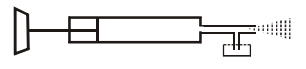
A spray gun is shown in the figure where a piston pushes air out of a nozzle. A thin tube of uniform cross section is connected to the nozzle. The other end of the tube is in a small liquid container. As the piston pushes air through the nozzle, the liquid from the container rises into the nozzle and is sprayed out. For the spray gun shown, the radii of the piston and the nozzle are $20 \ mm$ and $1 \ mm$ respectively. The upper end of the container is open to the atmosphere. $Image$

$1.$ If the piston is pushed at a speed of $5 \ mms ^{-1}$, the air comes out of the nozzle with a speed of

$(A)$ $0.1 \ ms ^{-1}$ $(B)$ $1 \ ms ^{-1}$ $(C)$ $2 \ ms ^{-1}$ $(D)$ $8 \ ms ^{-1}$

$2.$ If the density of air is $\rho_{ a }$ and that of the liquid $\rho_{\ell}$, then for a given piston speed the rate (volume per unit time) at which the liquid is sprayed will be proportional to

$(A)$ $\sqrt{\frac{\rho_{ a }}{\rho_{\ell}}}$ $(B)$ $\sqrt{\rho_a \rho_{\ell}}$ $(C)$ $\sqrt{\frac{\rho_{\ell}}{\rho_{ a }}}$ $(D)$ $\rho_{\ell}$

Give the answer question $1$ and $2.$

$1\,kg$ of water at $100\, ^{\circ}C$ is converted into steam at $100^{\circ}\,C$ by boiling at atmospheric pressure. The volume of water changes from $1.00 \times 10^{-3}\,m ^3$ as a liquid to $1.671\,m ^3$ as steam. The change in internal energy of the system during the process will be $........kJ$ (Given latent heat of vaporisaiton $=2257\,kJ / kg$. Atmospheric pressure $=1 \times 10^5\,Pa$ )
A particle is thrown vertically upwards with a velocity of $4\,ms^{-1}$. The ratio of its accelerations after $1\,s$ and $2\,s$ of its motion is
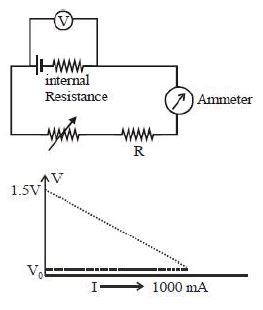
To verify Ohm's law, a student connects the voltmeter across the battery as, shown in the figure. The measured voltage is plotted as a function of the current, and the following graph is obtained If $V_0$ is almost zero, identify the correct statement