Given below are two statements :
Statement $I$ : When speed of liquid is zero everywhere, pressure difference at any two points depends on equation $\mathrm{P}_1-\mathrm{P}_2=\rho \mathrm{g}\left(\mathrm{h}_2-\mathrm{h}_1\right)$
Statement $II$ : In ventury tube shown $2 \mathrm{gh}=v_1^2-v_2^2$
In the light of the above statements, choose the most appropriate answer from the options given below.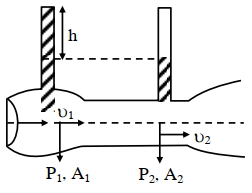
JEE MAIN 2024, Diffcult
Download our app for free and get started
Applying Bernoulli's equation
$\mathrm{P}_1+\rho \mathrm{gh}_1+\frac{1}{2} \rho v_1^2=\mathrm{P}_2+\rho \mathrm{gh}_2+\frac{1}{2} \rho v_2^2$
$\left[h_1 \& h_2\right.$ are height of point from any reference level]
$\text { Given } \mathrm{V}_1=\mathrm{V}_2=0 \text { (for statement-1) }$
$\therefore \mathrm{P}_1-\mathrm{P}_2=\rho \mathrm{g}\left(\mathrm{h}_2-\mathrm{h}_2\right)$
For statement-2
$\mathrm{P}_1+\frac{1}{2} \rho v_1^2=\mathrm{P}_2+\frac{1}{2} \rho v_2^2$
$\mathrm{P}_1-\mathrm{P}_2=\rho \mathrm{gh}$
$\mathrm{P}_1-\mathrm{P}_2=\frac{1}{2} \rho v_2^2-\frac{1}{2} \rho v_1^2$
$\rho \mathrm{gh}=\frac{1}{2} \rho v_2^2-\frac{1}{2} \rho v_1^2$
$2 \mathrm{gh}=\mathrm{v}_2^2-\mathrm{v}_1^2$
Hence answer $(4)$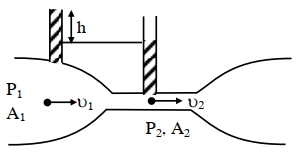

Download our appand get started for free
Experience the future of education. Simply download our apps or reach out to us for more information. Let's shape the future of learning together!No signup needed.*
Similar Questions
- 1The density of ice is $0.9 \,g / cm ^3$. What percentage by volume of the block of ice floats outside the water is ..........$\%$View Solution
- 2View SolutionWhich of the following graphs best represents the motion of a raindrop?
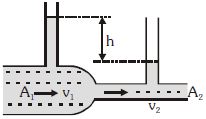
- 3A liquid flows through a horizontal tube. The velocities of the liquid in the two sections which have areas of cross-section $A_1$ and $A_2$ are $v_1$ and $v_2$ respectively. The difference in the levels of the liquid in the two vertical tubes is $h$ . The incorrect statement isView Solution
- 4A hollow sphere has inner volume half the outer volume. Its $4/5\,th$ part is submerged when placed in water. The density of material isView Solution
- 5The rate of flow of liquid in a tube of radius $r,$ length $ l,$ whose ends are maintained at a pressure difference $P$ is $V = \frac{{\pi QP\,{r^4}}}{{\eta l}}$ where $\eta $ is coefficient of the viscosity and $Q$ isView Solution
- 6A concrete sphere of radius $R$ has a cavity of radius $ r$ which is packed with sawdust. The specific gravities of concrete and sawdust are respectively $2.4$ and $0.3$ for this sphere to float with its entire volume submerged under water. Ratio of mass of concrete to mass of sawdust will beView Solution
- 7A cubical block of side $'a'$ and density $'\rho '$ slides over a fixed inclined plane with constant velocity $'v'$ . There is a thin film of viscous fluid of thickness $'t'$ between the plane and the block. Then the coefficient of viscosity of the thin film will beView Solution

- 8View SolutionA cork is submerged in water by a spring attached to the bottom of a pail. When the pail is kept in a elevator moving with an acceleration downwards, the spring length
- 9Karman line is a theoretical construct that separates the earth's atmosphere from outer space. It is defined to be the height at which the lift on an aircraft flying at the speed of a polar satellite $(8 \,km / s )$ is equal to its weight. Taking a fighter aircraft of wing area $30 \,m ^2$, and mass $7500 \,kg$, the height of the Karman line above the ground will be in the range .............. $km$ (assume the density of air at height $h$ above ground to be $\rho( h )=1.2 e ^{\frac{ h }{10}} \,kg / m ^3$ where $h$ is in $km$ and the lift force to be $\frac{1}{2} \rho v^2 A$, where $v$ is the speed of the aircraft and $A$ its wing area).View Solution
- 10A tank $5\, m$ high is half-filled with water and then is filled to the top with oil of density $0.85\, g/cm^3$. The pressure at the bottom of the tank, due to these liquids is ....... $g\, dyne/cm^2$View Solution