MCQ
Given below are two statements :

Statement $I$ : When speed of liquid is zero everywhere, pressure difference at any two points depends on equation $\mathrm{P}_1-\mathrm{P}_2=\rho \mathrm{g}\left(\mathrm{h}_2-\mathrm{h}_1\right)$

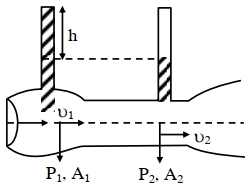
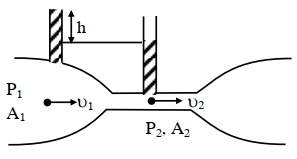
Statement $II$ : In ventury tube shown $2 \mathrm{gh}=v_1^2-v_2^2$

In the light of the above statements, choose the most appropriate answer from the options given below.
  • A
    Both Statement $I$ and Statement $II$ are correct.
  • B
    Statement $I$ is incorrect but Statement $II$ is correct.
  • C
    Both Statement $I$ and Statement $II$ are incorrect.
  • Statement $I$ is correct but Statement $II$ is incorrect.
Answer

Correct option: D.
Statement $I$ is correct but Statement $II$ is incorrect.
d
Applying Bernoulli's equation

$\mathrm{P}_1+\rho \mathrm{gh}_1+\frac{1}{2} \rho v_1^2=\mathrm{P}_2+\rho \mathrm{gh}_2+\frac{1}{2} \rho v_2^2$

$\left[h_1 \& h_2\right.$ are height of point from any reference level]

$\text { Given } \mathrm{V}_1=\mathrm{V}_2=0 \text { (for statement-1) }$

$\therefore \mathrm{P}_1-\mathrm{P}_2=\rho \mathrm{g}\left(\mathrm{h}_2-\mathrm{h}_2\right)$

For statement-2

$\mathrm{P}_1+\frac{1}{2} \rho v_1^2=\mathrm{P}_2+\frac{1}{2} \rho v_2^2$

$\mathrm{P}_1-\mathrm{P}_2=\rho \mathrm{gh}$

$\mathrm{P}_1-\mathrm{P}_2=\frac{1}{2} \rho v_2^2-\frac{1}{2} \rho v_1^2$

$\rho \mathrm{gh}=\frac{1}{2} \rho v_2^2-\frac{1}{2} \rho v_1^2$

$2 \mathrm{gh}=\mathrm{v}_2^2-\mathrm{v}_1^2$

Hence answer $(4)$

Need a full question paper?

Generate a complete, print-ready paper with questions like this in minutes — across 16+ boards, with answer keys.

Start Generating Free

Similar questions

The amplitude of a particle executing $SHM$ is made three-fourth keeping its time period constant. Its total energy will be
A ball of mass $m$ moving with velocity $v$ collides head-on with the second ball of mass $m$ at rest. If the coefficient of restitution is $e$ and velocity of first ball after collision is $v_1$ and velocity of second ball after collision is $v_2$ then
The surface tension of a liquid is $70\,dyne/cm$. In $MKS$ system its value is 
Huygens' principle of secondary wavelets may be used to:
  1. Find the velocity of light in vacuum.
  2. Explain the particle behaviour of light.
  3. Find the new position of a wavefront.
  4. Explain Snell's law.
A wheel is rotating about an axis through its centre at $720\, rpm$. It is acted on by a constant torque opposing its motion for $8\, seconds$ to bring it to rest finally. The value of torque (in $N-m$) is  (Given $I = \frac{{24}}{\pi }kg - {m^2}$ )
During propagation of a plane progressive mechanical wave:
Two particles $A$ and $B$ are connected by rigid rod $A B$. The rod slides along perpendicular rails as shown here. The velocity of $A$ to the left is $10\; m / s$. What is the velocity of $B$(in $m/s$) when angle $\alpha=60^{\circ}$?
The amplitude of a simple pendulum, oscillating in air with a small spherical bob, decreases from $10\, cm$ to $8\, cm$ in $40\, seconds$ . Assuming that Stokes law is valid, and ratio of the coefficient of viscosity of air to that of carbon dioxide is $1.3$ . The time in which amplitude of this pendulum will reduce from $10\, cm$ to $5\, cm$ in carbon dioxide will be close to ..... $s$ $(ln\, 5 = 1.601,ln\, 2 = 0 .693)$
The pressure of an ideal gas is written as $\text{p}=\frac{2\text{E}}{3\text{v}}.$ Here E refers to:
The work done in blowing a soap bubble of radius $r$ of the solution of surface tension $T$ will be