MCQ
Given below are two statements:
Statement (I) : When currents vary with time, Newton's third law is valid only if momentum carried by the electromagnetic field is taken into account.
Statement (II) : Ampere's circuital law does not depend on Biot-Savart's law.
In the light of the above statements, choose the correct answer from the options given below:

Answer

Correct option: B.
Statement I is true but Statement II is false.
(B) Conceptual.

Need a full question paper?

Generate a complete, print-ready paper with questions like this in minutes — across 16+ boards, with answer keys.

Start Generating Free

Similar questions

Water has maximum density at
A horizontal bridge is built across a river. A student standing on the bridge throws a small ball vertically upwards with a velocity $4\,m s ^{-1}$. The ball strikes the water surface after $4\,s$. The height of bridge above water surface is $......\,m$ $\left(\right.$ Take $\left.g=10\,m s ^{-2}\right)$
The current in a coil decreases from $1 \,A$ to $0.2\, A$. In $10\,sec$. Calculate the coefficient of self inductance. If induced $e.m.f.$ is $0.4\, volt$......$H$
Two persons are holding a rope of negligible weight tightly at its ends so that it is horizontal. A $15\, kg$ weight is attached to the rope at the mid-point, which now no longer remains horizontal. The minimum tension required to completely straighten the rope is
A bag is gently dropped on a conveyor belt moving at a speed of $2\,m / s$. The coefficient of friction between the conveyor belt and bag is $0.4$ Initially, the bag slips on the belt before it stops due to friction. The distance travelled by the bag on the belt during slipping motion is $.....m$ [Take $g=10\,m / s ^{-2}$ ]
An $\alpha$ particle and a proton are accelerated from rest through the same potential difference. The ratio of linear momenta acquired by above two particals will be.
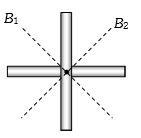
Two identical rods each of mass $M$. and length $l$ are joined in crossed position as shown in figure. The moment of inertia of this system about a bisector would be 
Sunlight of intensity $1.3 kW m ^{-2}$ is incident normally on a thin convex lens of focal length $20 cm$. Ignore the energy loss of light due to the lens and assume that the lens aperture size is much smaller than its focal length. The average intensity of light, in $kW m ^{-2}$, at a distance $22 cm$ from the lens on the other side is. . . . .
Due to the flow of current in a circular loop of radius $R$, the magnetic induction produced at the centre of the loop is $B$. The magnetic moment of the loop is $({\mu _0} = {\rm{permeability}}\,{\rm{constant)}}$
A damped harmonic oscillator has a frequency of $5$ oscillations per second. The amplitude drops to half its value for every $10$ oscillations. The time it will take to drop to $\frac{1}{1000}$ of the original amplitude is close to .... $s$