Question
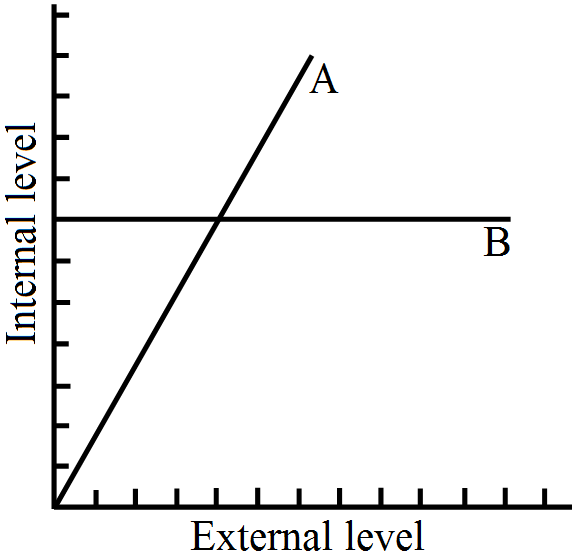
Given below is a graph depicting organismic response to changing external conditions. According to their response the organisms are grouped into two types. Name the type which will show (i) Pattern A (ii) Pattern B.
Answer

A- Conformers.
B- Regulators.

Need a full question paper?

Generate a complete, print-ready paper with questions like this in minutes — across 16+ boards, with answer keys.

Start Generating Free

Similar questions

Why does the 'insertional inactivation' method to detect recombinant DNA is preferred to 'antibiotic resistance' procedure?
Bio-diversification of life started to occur almost 3 billion years ago. Since then new species have been evolving and then disappearing en masse from earth.
a. How many episodes of mass extinctions of species have already taken place and which one is in progress in the current era?
b. How is current episode in progress different from the previous episodes and why? Explain.
A doctor prescribed morphine as a sedative and pain killer to your cousin who had undergone surgery. Even after recovery, he craved for the prescribed medicine. What do you conclude about his condition, had he continued with the same medication? After appraising yourself, what measures will you suggest to him to overcome this problem? Briefly explain any two.
Mention the charateristics of the first ape man Australopithecus africanus.
What are ecological pyramids. Which point should be kept in mind while calculating it. Draw a diagram of energy pyramid of a grass ecosystem.
  1. Describe in sequence, the process of microsporogenesis in angiosperms.
  2. Draw a labelled diagram of a two-celled final structure formed.
Transplantation to save certain patients often fails due to rejection by the patient. What is transplantation? Which type of immune response is responsible for such rejections?
What are the three types of RNA? Mention their relation to protein synthesis.
  1. What is Gene therapy?
  2. Describe the procedure of such a therapy that could be a permanent cure for a disease. Name the disease.
A spermatogonial cell has 30 chromosomes. How many chromosomes will be found in:
  1. The primary spermatocyte.
  2. The spermatid?