MCQ
Given

$E^o_{Cl_2/Cl^-} = 1.36\,V,$   $E^o_{Cr^{3+}/Cr}= -0.74\,V,$

$E^o_{Cr_2/O_7^{2-}/Cr^{3+}}=1.33\,V,$   $E^o_{MnO^-_4/Mn^{2+}} = 1.51\,V$

Among the following, the strongest reducing agent is

  • $Cr$
  • B
    $Mn^{2+}$
  • C
    $Cr^{+3}$
  • D
    $Cl^-$

Answer

Correct option: A.
$Cr$
a
Lower the reduction potential, greater is the tendency of the element to get oxidized, hence, greater is the reducing ability. Since, chromium system has lowest reduction potential; therefore, it is the strongest reducing agent.

Need a full question paper?

Generate a complete, print-ready paper with questions like this in minutes — across 16+ boards, with answer keys.
Start Generating Free

Similar questions

Most reactive toward acid catalyst dehydration is
For a first order reaction $A \rightarrow B$, the rate constant, $k =5.5 \times 10^{-14} \,s ^{-1}$. The time required for $67\, \%$ completion of reaction is $x \,\times 10^{-1}$ times the half life of reaction. The value of $x$ is $....$ (Nearest integer)
Assertion : Alkylbenzene is not prepared by Friedel-Crafts alkylation of benzene.
Reason : Alkyl halides are less reactive than acyl halides.
$K_2MnO_4$ can be converted into $KMnO_4$ by
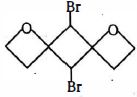
Number of optically active isomer is/are
For a reaction, activation energy $\mathrm{E}_{\mathrm{a}}=0$ and the rate constant at $200\; \mathrm{K}$ is $1.6 \times 10^{6} \;\mathrm{s}^{-1} .$ The rate constant at $400\; \mathrm{K}$ will be glven that gas constant]

$\mathrm{R}=8.314\; \mathrm{JK}^{-1} \mathrm{mol}^{-1}$

Equal volumes of three acid solutions of $pH \,3, 4$ and $5$ are mixed in a vessel.  .........$  \times  10^{-4} \,M$ will be the $H^+$ ion concentration in the mixture ?
The appropriate naming for the second step in the haloform reaction is:
The alcohol which is most readily dehydrated is:
Liquid $‘M’$ and liquid $‘N’$ form an ideal solution. The vapour pressures of pure liquids $‘M’$ and $‘N’$ are $450$ and $700\,mmHg,$ respectively at the same temperature. Then correct statement is:
$( x_M =$ mole fraction of $‘M’$ in solution; $x_N =$ mole fraction of $‘N’$ in solution;
$y_M =$ mole fraction of $‘M’$ in vapour phase; $y_N =$ mole fraction of $‘M’$ in vapour phase$)$