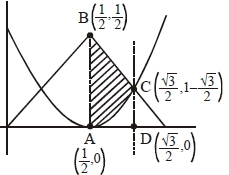
MCQ
Given : $f(x)=\left\{\begin{array}{ccc}{x} & {,} & {0 \leq x < \frac{1}{2}} \\ {\frac{1}{2}} & {,} & {x=\frac{1}{2}} \\ {1-x} & {,} & {\frac{1}{2} < x \leq 1}\end{array}\right.$

and $g(x)=\left(x-\frac{1}{2}\right)^{2}, x \in R .$ Then the area (in sq. units) of the region bounded by the curves, $y=f(x)$ and $y=g(x)$ between the lines, $2 \mathrm{x}=1$ and $2 \mathrm{x}=\sqrt{3},$ is

  • A
    $\frac{1}{3}+\frac{\sqrt{3}}{4}$
  • $\frac{\sqrt{3}}{4}-\frac{1}{3}$
  • C
    $\frac{1}{2}+\frac{\sqrt{3}}{4}$
  • D
    $\frac{1}{2}-\frac{\sqrt{3}}{4}$

Answer

Correct option: B.
$\frac{\sqrt{3}}{4}-\frac{1}{3}$
b
Required area $=$ Area of trepezium ABCD -

Area of parabola between $x=\frac{1}{2}$ and $ x=\frac{\sqrt{3}}{2}$

$A=\frac{1}{2}\left(\frac{\sqrt{3}}{2}-\frac{1}{2}\right)\left(\frac{1}{2}+1-\frac{\sqrt{3}}{2}\right)-\int_{1 / 2}^{\sqrt{3} / 2}\left(x-\frac{1}{2}\right)^{2} d x$$=\frac{\sqrt{3}}{4}-\frac{1}{3}$

Need a full question paper?

Generate a complete, print-ready paper with questions like this in minutes — across 16+ boards, with answer keys.

Start Generating Free

Similar questions

If $\int \sqrt{\sec 2 x-1} d x=\alpha \log _e\left|\cos 2 x+\beta+\sqrt{\cos 2 x\left(1+\cos \frac{1}{\beta} x\right)}\right|+$ constant, then $\beta-\alpha$ is equal to
In an LPP, if the objective function Z = ax + by has the same maximum value on two corner points of the feasible region, then the number of points of which Zmax occurs is:
  1. 0
  2. 2
  3. Finite
  4. Infinite
The value of $x$  obtained from the equation $\left| {\,\begin{array}{*{20}{c}}{x + \alpha }&\beta &\gamma \\\gamma &{x + \beta }&\alpha \\\alpha &\beta &{x + \gamma }\end{array}\,} \right| = 0$ will be
$(\vec{a} \cdot \hat{i})^2+(\vec{a} \cdot \hat{j})^2+(\vec{a} \cdot \hat{k})^2$ is equal to
Function $f: N \rightarrow N , f(x)=\left\{\begin{array}{l}x+1, x \text { is odd } \\ x-1, x \text { is even }\end{array}\right.$ is defined then, $f$ is __________ .
A unit vector perpendicular to both $\hat{\text{i}}+\hat{\text{j}}$ and $\hat{\text{j}}+\hat{\text{k}}$ is:
  1. $\hat{\text{i}}-\hat{\text{j}}+\hat{\text{k}}$
  2. $\hat{\text{i}}+\hat{\text{j}}+\hat{\text{k}}$
  3. $\frac{1}{\sqrt{3}}\big(\hat{\text{i}}+\hat{\text{j}}+\hat{\text{k}}\big)$
  4. $\frac{1}{\sqrt{3}}\big(\hat{\text{i}}-\hat{\text{j}}+\hat{\text{k}}\big)$
The positive integral solution of the equation

$\tan^{-1}\text{x}+\cos^{-1}\frac{\text{y}}{\sqrt{1+\text{y}^2}}=\sin^{-1}\frac{3}{\sqrt{10}}$ is:

  1. x = 1, y = 2
  2. x = 2, y = 1
  3. x = 3, y = 2
  4. x = -2, y = -1
$\int_{}^{} {\frac{{\sin x\;dx}}{{{a^2} + {b^2}{{\cos }^2}x}}} = $
The order of a matrix $\begin{bmatrix}2&\text{amp};5 &\text{amp};7 \end{bmatrix}$ is:
  1. 3 × 3
  2. 1 × 1
  3. 3 × 1
  4. 1 × 3
$\int_{}^{} {\frac{{\sin x + \cos x}}{{\sqrt {1 + \sin 2x} }}\;dx = } $