Question
Given $\left| {{\vec A_1}} \right| = 2,\,\left| {{\vec A_2}} \right| = 3$ and $\left| {{{\vec A}_1} + {{\vec A}_2}} \right| = 3$.  Find the value or $\left| {\left( {{{\vec A}_1} + 2{{\vec A}_2}} \right) \times \left( {3{{\vec A}_1} - 4{{\vec A}_2}} \right)} \right|$

Answer

Get the step-by-step solution for this question inside the Vidyadip app.

Get the answer in the app

Need a full question paper?

Generate a complete, print-ready paper with questions like this in minutes — across 16+ boards, with answer keys.

Start Generating Free

Similar questions

The correct order of their reactivity towards hydrolysis at room temperature is :
The refractive index of water is $1.33.$ What will be the speed of light in water
A body of mass ${M}$ moving at speed ${V}_{0}$ collides elastically with a mass $'m'$ at rest. After the collision, the two masses move at angles $\theta_{1}$ and $\theta_{2}$ with respect to the initial direction of motion of the body of mass ${M}$. The largest possible value of the ratio ${M} / {m}$, for which the angles $\theta_{1}$ and $\theta_{2}$ will be equal, is :
An electron having charge $1.6 \times {10^{ - 19}}\,C$ and mass $9 \times {10^{ - 31}}\,kg$ is moving with $4 \times {10^6}\,m{s^{ - 1}}$ speed in a magnetic field $2 \times {10^{ - 1}}\,tesla$ in a circular orbit. The force acting on electron and the radius of the circular orbit will be
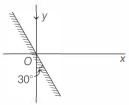
A mirror is placed at an angle of $30^{\circ}$ with respect to $Y$-axis (see figure). A light ray travelling in the negative $y$-direction strikes the mirror. The direction of the reflected ray is given by the vector
If density of earth increased $4 $ times and its radius become half of what it is, our weight will
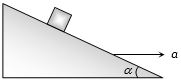
A block is kept on a frictionless inclined surface with angle of inclination '$\alpha$'. The incline is given an acceleration $ 'a'$ to keep the block stationary. Then a is equal to
The energy liberated on complete fission of $1\, kg$ of $_{92}{U^{235}}$ is (Assume $200\, MeV$ energy is liberated on fission of $1$ nucleus)
The maximum horizontal range of a projectile is $160\, m$. When the projectile is thrown  with the same speed at an elevation of $30^o$ from the horizontal, it will reach to the  maximum height of   ......... $m$
Two point masses of $0.3\ kg$ and $0.7\ kg$ are fixed at the ends of a rod of length $1.4\ m$  and of negligible mass. The rod is set rotating about an axis perpendicular  to its length with a uniform angular speed. The point on the rod through which the axis should pass in order that the work required for rotation of the rod is minimum is located at a distance of