MCQ
Given $\left| {{\vec A_1}} \right| = 2,\,\left| {{\vec A_2}} \right| = 3$ and $\left| {{{\vec A}_1} + {{\vec A}_2}} \right| = 3$.  Find the value or $\left| {\left( {{{\vec A}_1} + 2{{\vec A}_2}} \right) \times \left( {3{{\vec A}_1} - 4{{\vec A}_2}} \right)} \right|$
  • $64$
  • B
    $60$
  • C
    $62$
  • D
    $61$

Answer

Correct option: A.
$64$
a

Need a full question paper?

Generate a complete, print-ready paper with questions like this in minutes — across 16+ boards, with answer keys.

Start Generating Free

Similar questions

A planet is orbiting the sun in an elliptical orbit. Let $U$ denote the potential energy and $K$ denote the kinetic energy of the planet at an arbitrary point on the orbit. Choose the correct statement.
The length of a wire increases by 1% by a load of 2kg-wt. The linear strain produced in the wire will be:
The $SI$ unit of mechanical equivalent of heat is
 A thin uniform rod has moment of inertia l about an axis parallel to its length at a certain distance. If on heating its length increases by 20%, then moment of inertia of rod will change by:
Two bodies A and B having equal surface areas are maintained at temperatures 10°C and 20°C. The thermal radiation emitted in a given time by A and B are in the ratio:
  1. 1 : 1.15
  2. 1 : 2
  3. 1 : 4
  4. 1 : 16
A particle $(A)$ is dropped from a height and another particle $(B)$ is thrown in horizontal direction with speed of $5\; m/sec$ from the same height. The correct statement is
If the time period $(T)$ of vibration of a liquid drop depends on surface tension $(S)$, radius $(r)$ of the drop and density $(\rho )$ of the liquid, then the expression of $T$ is
Two bodies performing $SHM$ have same amplitude and frequency. Their phases at a certain instant are as shown in the figure. The phase difference between them is
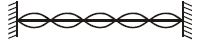
A string fixed at its both ends vibrates in $5\,\,loops$  as shown in the figure  

The total number of nodes and antinodes are respectively

Equation of a plane progressive wave is given by $\text{y}=0.6\sin2\pi\Big(\text{t}-\frac{\text{x}}{2}\Big).$ On reflection from a denser medium its amplitude becomes 2/3 of the amplitude of the incident wave. The equation of the reflected wave is:

  1. $\text{y}=0.6\sin2\pi\Big(\text{t}+\frac{\text{x}}{2}\Big)$

  2. $\text{y}=-0.4\sin2\pi\Big(\text{t}+\frac{\text{x}}{2}\Big)$

  3. $\text{y}=0.4\sin2\pi\Big(\text{t}+\frac{\text{x}}{2}\Big)$

  4. $\text{y}=-0.4\sin2\pi\Big(\text{t}-\frac{\text{x}}{2}\Big)$