MCQ
Given, $\ce{|A + B| = P, |A - B| = Q.}$ The value of $\ce{P^2 + Q^2}$ is:
  • $\ce{2(A^2 + B^2)}$
  • B
    $\ce{A^2 - B^2}$
  • C
    $\ce{A^2 + B^2}$
  • D
    $\ce{2(A^2 - B^2)}$

Answer

Correct option: A.
$\ce{2(A^2 + B^2)}$

Need a full question paper?

Generate a complete, print-ready paper with questions like this in minutes — across 16+ boards, with answer keys.
Start Generating Free

Similar questions

The linear momentum $p$ of a body moving in one dimension varies with time according to the equation $p = a + b{t^2}$ where a and b are positive constants. The net force acting on the body is
A stone tied to the end of a string of $1\, m$ long is whirled in a horizontal circle with a constant speed. If the stone makes $22$ revolution in $44\, seconds$, what is the magnitude and direction of acceleration of the stone?
Two samples $A$ and $B$ of a gas initially at the same pressure and temperature are compressed from volume $ V$ to $ V/2$ ($A$ isothermally and adiabatically). The final pressure of $ A$ is
The planes of two rigid discs are perpendicular to each other. They are rotating about their axes. If their angular velocities are $3 \,rad/sec$ and $4\, rad/sec$ respectively, then the resultant angular velocity of the system would be ........ $rad/sec$
A ball is dropped vertically from a height of $h$ onto a hard surface. If the ball rebounds from the surface with a fraction $r$ of the speed with which it strikes the latter on each impact, what is the net distance travelled by the ball up to the 10th impact?
When a ceiling fan is switched off its angular velocity reduces to $50\%$ while it makes $ 36$ rotations. How many more rotation will it make before coming to rest (Assume uniform angular retardation)
A particle performs $SHM$ on $x-$ axis with time period of $0.5\,sec,$ such that it's velocity is zero at $x = -3\,cm$ and at $x = 9\,cm$. It was located at $x = 0$ and moving in negative $'x'$ at $t = 0$. The equation of $SHM$ of the particle is
The potential energy function (in J) of a particle in a region of space is given as $U=\left(2 x^2+3 y^3+2 z\right)$. Here $\mathrm{x}, \mathrm{y}$ and $\mathrm{z}$ are in meter. The magnitude of $\mathrm{x}$ - component of force (in $\mathrm{N}$ ) acting on the particle at point $\mathrm{P}(1,2,3)\ \mathrm{m}$ is:
A beaker containing a liquid of density $\rho $ moves up with an acceleration $a$ ; the pressure due to the liquid at a depth $h$ below the free surface of the liquid is
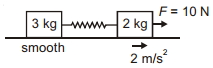
What is the acceleration of $3 \,kg$ mass when acceleration of $2 \,kg$ mass is $2 \,m / s ^2$ as shown is ............... $m / s ^2$