Question
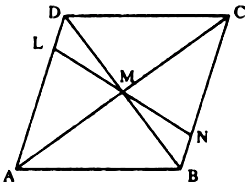
Given: Parallelogram $ABCD$ in which diagonals $AC$ and $BD$ intersect at $M$. Prove: $M$ is the mid$-$point of $LN$.

Answer


Proof: Diagonals of gm bisect each other.
$MD = MB$
Also $\angle ADB = \angle DBN ($Alternate$ \angle s)$
$\angle DML = \angle BMN ($Vert. opp. $\angle s)$
$\triangle DML = \triangle BMN$
$LM = MN$
$M$ is mid$-$point of $LN$.
Hence proved.

Need a full question paper?

Generate a complete, print-ready paper with questions like this in minutes — across 16+ boards, with answer keys.

Start Generating Free

Similar questions

A contractor undertakes to dig a canal, $6$ kilometers long, in $35$ days and employed $90$ men. He finds that after $20$ days only $2\  \text{km}$ of the canal has been completed. How many more men must be employed to finish the work on time?
If $\mathrm{a}-\frac{1}{\mathrm{a}}=4$, find $: \mathrm{a}^2+\frac{1}{\mathrm{a}^2}$
Half of a herd of deer are grazing in the field and three-fourths of the remaining are playing nearby. The rest 9 are drinking water from the pond.
Q.1. If $x$ represents the total number of deer in the herd, which of the following equations holds true?
(a) $\frac{x}{2}+\frac{3 x}{4}=x+9$ $\quad$ (b) $\frac{x}{2}+\frac{3 x}{8}=x+9$ $\quad$ (c) $\frac{x}{2}+\frac{3 x}{4}=x-9$ $\quad$ (d) $\frac{x}{2}+\frac{3 x}{4}=x-9$
Q.2. The total number of deer in the herd is:
(a) 63 $\quad$ (b) 72 $\quad$ (c) 81 $\quad$ (d) 90
Q.3. If there is one attendant for every four grazing, deer, how many attendants are there ?
(a) 8 $\quad$ (b) 9 $\quad$ (c) 16 $\quad$ (d) 18
Q.4. The ratio between the number of deer grazing those playing and those drinking water from the pond is :
(a) $3: 2: 1$ $\quad$ (b) $4: 3: 1$ $\quad$ (c) $4: 3: 2$ $\quad$ (d) $9: 3: 1$
Find the amount and the compound interest on ₹ $16,000$ for $3$ years at $5\%$ per annum compounded annually.
Divide : $14 x^3 y^4-7 x^4 y^3-28 x^3 y^6$ by $-7 x^3 y^2$
Use direct method to evaluate the following products : $(x + 8)(x + 3)$
The fine imposed (in rupees) on 40 pupils for being absent is given below :
$
\begin{array}{l}
18,8,12,6,8,16,12,5,23,2,16,23,2,10,20,12,9,7,0,5 \\
3,6,27,21,19,15,20,24,2,16,14,8,23,24,10,14,3,8,11,2
\end{array}
$
Present the data in the form of frequency distribution table by taking class intervals $0-5,5-10,10-15,15-20,20-25$.
The heights of 45 students measured to the nearest centimetre are given below :
$
\begin{array}{l}
155,166,159,161,158,154,153,159,157,152,160,157,158,170 \\
152,151,162,164,171,154,165,161,150,168,162,154,160,170,163,164 \\
165,169,165,155,157,158,160,161,156,153,150,165,167,169,172
\end{array}
$
Prepare a frequency table taking class intervals
$
150-155,155-160,160-165,165-170,170-175 .
$
The length, breadth, and height of a cuboid are in the ratio $5 : 3: 2$. If its volume is $240 \ cm^3;$ find its dimensions. Also, find the total surface area of the cuboid.
If the same number be added to the numbers $5, 11, 15$ and $31,$ the resulting numbers are in proportion. Find the number.