MCQ
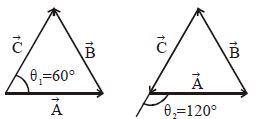
Given that; $A = B = C$. If $\vec A + \vec B = \vec C,$ then the angle between $\vec A$ and $\vec C$ is $\theta _1$. If $\vec A + \vec B+ \vec C = 0,$ then the angle between $\vec A$ and $\vec C$ is $\theta _2$. What is the relation between $\theta _1$ and $\theta _2$ ?
  • A
    $\theta _1=\theta _2$
  • $\theta _1=\theta _2/2$
  • C
    $\theta _1=2\theta _2$
  • D
    None of these

Answer

Correct option: B.
$\theta _1=\theta _2/2$
b

Need a full question paper?

Generate a complete, print-ready paper with questions like this in minutes — across 16+ boards, with answer keys.

Start Generating Free

Similar questions

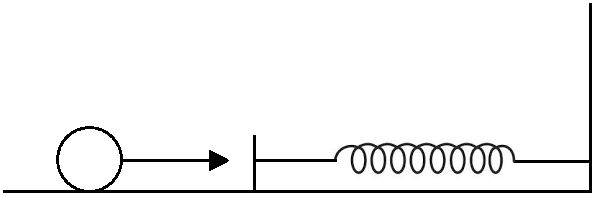
A mass of $0.5\ kg$ moving with a speed of $1.5\ ms^{-1}$ on a horizontal smooth surface, collides with a nearly weightless spring of spring constant $k = 50\ N/ m^{-1}$

The maximum compression of the spring would be:
Turpentine oil is flowing through a tube of length $l$ and radius $r$. The pressure difference between the two ends of the tube is $P .$ The viscosity of oil is given by $\eta=\frac{P\left(r^{2}-x^{2}\right)}{4 v l}$ where $v$ is the velocity of oil at a distance $x$ from the axis of the tube. The dimensions of $\eta$ are
A train of $150$ metre length is going towards north direction at a speed of $10\; m / s$. A parrot flies at the speed of $5\; m / s$ towards south direction parallel to the railways track. The time taken by the parrot to cross the train is
A new temperature scale uses $X$ as a unit of temperature, where the numerical value of the temperature $t_x$ in this scale is related to the absolute temperature $T$ by $t_x=3 T+100$. If the specific heat of a material using this unit is $1400 \,J kg ^{-1} K ^{-1}$, its specific heat in the SI system of units is
A cracker rocket is ejecting gases at a rate of $0.05 \,kg / s$ with a velocity $400 \,m / s$. The accelerating force on the rocket is
A rope is wound round a hollow cylinder of mass $5\,kg$ and radius $0.5\,m.$ ........ $rad/s^2$ is the angular acceleration of the cylinder if the rope is pulled with a force of $20\,N$ ?
Suppose a container ia evacuated to leave just one molecule of a gas in it. Let $\mathrm{V}_{\mathrm{a}}$ and $\mathrm{v}_{\mathrm{rms}}$ represent the average speed and the $\text{rms}$ speed of the gas.
When forces $F_1, F_2, F_3$ are acting on a particle of mass $m$ such that $F_2$ and $F_2$ are mutually perpendicular, then the particle remain stationary. If the force $F_1$ is now removed, then the acceleration of the particle is:
How much energy will be necessary for making a body of 500 kg escape from the earth $[g = 9.8\,m/{s^2}$, radius of earth $ = 6.4 \times {10^6}\,m]$
Water is flowing through a tube of non-uniform cross-section ratio of the radius at entry and exit end of the pipe is $ 3 : 2.$  Then the ratio of velocities at entry and exit of liquid is