MCQ
Given that $\left[\begin{array}{ll}1 & x\end{array}\right]\left[\begin{array}{cc}4 & 0 \\ -2 & 0\end{array}\right]=0$, the value of $x$ is :
  • A
    -4
  • B
    -2
  • C
    2
  • D
    4

Answer

$\begin{array}{l}\text {We have, }\left[\begin{array}{ll}1 & x\end{array}\right]\left[\begin{array}{cc}4 & 0 \\ -2 & 0\end{array}\right]=0 \\ \Rightarrow \quad[1 \times 4+x \times(-2) \quad 1 \times 0+x \times 0]=\left[\begin{array}{ll}0 & 0\end{array}\right] \\ \Rightarrow \quad 4-2 x=0 \Rightarrow 4=2 x \Rightarrow x=2\end{array}$

Need a full question paper?

Generate a complete, print-ready paper with questions like this in minutes — across 16+ boards, with answer keys.

Start Generating Free

Similar questions

If $y = {x^2} + \cos \,2x + {e^{ax}}$ then find $\frac{{dy}}{{dx}}$
If P be the point (2, 6, 3) then the equation of the plane trough P, at right angles to OP, where ′O′ is the origin is:
Let A = {2, 3, 4, 5, ..., 17, 18}. Let $'\simeq'$ be the equivalence relation on A × A, cartesian product of A with itself, defined by $(\text{a, b})\simeq(\text{c, d)}$ if ad = bc. Then, the number of ordered pairs of the equivalence class of (3, 2) is:
  1. 4
  2. 5
  3. 6
  4. 7
The value of $\int_0^{\pi /2} {\frac{{\sin x}}{{1 + {{\cos }^2}x}}\,dx} $ is
$\int_{}^{} {\sec x\;dx = } $
Let $A=\left[a_{i j}\right]$ be a $3 \times 3$ matrix, where

$a_{i j}= 1 , \quad\quad\text { if } i=j$

$\quad\quad-x ,\quad \text { if }|i-j|=1$

$\quad\quad2 x+1, \text { otherwise }$

Let a function f: $\mathrm{R} \rightarrow \mathrm{R}$ be defined as $\mathrm{f}(\mathrm{x})=\operatorname{det}(\mathrm{A})$. Then the sum of maximum and minimum values of $f$ on $R$ is equal to:

For a polynomial $g ( x )$ with real coefficient, let $m _{ g }$ denote the number of distinct real roots of $g ( x )$. Suppose $S$ is the set of polynomials with real coefficient defined by

$S=\left\{\left(x^2-1\right)^2\left(a_0+a_1 x+a_2 x^2+a_3 x^3\right): a_0, a_1, a_2, a_3 \in R\right\} \text {. }$

For a polynomial $f$, let $f^{\prime}$ and $f^{\prime \prime}$ denote its first and second order derivatives, respectively. Then the minimum possible value of $\left(m_f+m_{f^{\prime}}\right)$, where $f \in S$, is. . . . . . . .
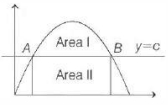
The figure shows a portion of the graph $y=2 x-4 x^3$.The line $y=c$ is such that the areas of the regions marked $I$ and $II$ are equal. If $a, b$ are the $x$-coordinates of $A, B$ respectively, then $a+b$ equals
If $y =\frac{{{x^4} - {x^2} + 1}}{{{x^2} + \sqrt 3 x + 1}}$ and $\frac{{dy}}{{dx}} = ax + b$ then the value of $a + b$ is equal to
The difference between the greatest and the least values of the function, $f (x) = sin2x - x$ on $\left[ { - \,\frac{\pi }{2}\,\,,\,\,\frac{\pi }{2}} \right]$