MCQ
Given that $\vec A\, + \,\vec B\, = \,\vec C\,.$  If  $\left| {\vec A} \right|\, = \,4,\,\,\left| {\vec B} \right|\, = \,5\,\,$ and $\left| {\vec C} \right|\, =\,\sqrt {61}$ the angle between $\vec A\,\,$ and $\vec B$ is ....... $^o$
  • A
    $30$
  • $60$
  • C
    $90$
  • D
    $120$

Answer

Correct option: B.
$60$
b

Need a full question paper?

Generate a complete, print-ready paper with questions like this in minutes — across 16+ boards, with answer keys.

Start Generating Free

Similar questions

What will be the phase difference between virtual voltage and virtual current, when the current in the circuit is wattless.....$^o$
A cylinder with fixed capacity of $67.2\, lit$ contains helium gas at $STP$. The amount of heat needed to raise the temperature of the gas by $20\,^oC$ is ..... $J$ [Given that $R = 8.31\, J\, mol^{-1}\, K^{-1}$]
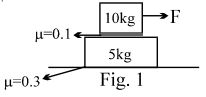
When $F = 2N$, the frictional force between $10 kg$ block and $5 kg$ block is ...... $N$
A stone is dropped into water from a bridge $44.1\,m$ above the water. Another stone is thrown vertically downward $1$ sec later. Both strike the water simultaneously. What was the initial speed of the second stone.......$m/s$
In a uniform magnetic field of $0.049 \mathrm{~T}$, a magnetic needle performs $20$ complete oscillations in $5$ seconds as shown. The moment of inertia of the needle is $9.8 \times 10^{-5} \mathrm{~kg} \mathrm{~m}^2$. If the magnitude of magnetic moment of the needle is $x \times 10^{-5} \mathrm{Am}^2$, then the value of ' $x$ ' is :
While measuring the thermal conductivity of a liquid, we keep the upper part hot and lower part cool, so that
Which level of the single ionized carbon has the same energy as the ground state energy of hydrogen atom ?
In a tug-of-war contest, two men pull on a horizontal rope from opposite sides. The winner will be the man who
The ratio of the weights of a body on the Earth's surface to that on the surface of a planet is $9 : 4$. The mass of the planet is $\frac{1}{9}^{th}$ of that of the Earth. If $'R'$ is the radius of the Earth, what is the radius of the planet ? (Take the planets to have the same mass density)
In the figure shown, the two identical balls of mass $M$ and radius $R$ each, are placed in contact with each other on the frictionless horizontal surface. The third ball of mass $M$ and radius $R/2$, is coming down vertically and has a velocity $= v_0$ when it simultaneously hits the two balls and the smaller ball does not stop after collision, but continues to move downwards with $a$ speed $= v_0/2$, after the collision. Then, the speed of each bigger ball after collision is