MCQ
Given vector $\overrightarrow A = 2\hat i + 3\hat j, $ the angle between $\overrightarrow A $and $y-$axis is
  • A
    ${\tan ^{ - 1}}3/2$
  • ${\tan ^{ - 1}}2/3$
  • C
    ${\sin ^{ - 1}}2/3$
  • D
    ${\cos ^{ - 1}}2/3$

Answer

Correct option: B.
${\tan ^{ - 1}}2/3$
b
(b) $\vec{A}=2 \hat{i}+3 \hat{j}$

$A=|\vec{A}|=\sqrt{4+9}=\sqrt{13}$

$\cos \beta=\frac{y}{A}=\frac{3}{\sqrt{13}}$

$\cos \beta=\frac{3}{\sqrt{13}}$

$\sin \beta=\frac{x}{A}=\frac{2}{\sqrt{13}}$

$\operatorname{Tan} \beta =\frac{x}{y}=\frac{2}{3}$

$=\tan ^{-1}\left(\frac{2}{3}\right)$

Need a full question paper?

Generate a complete, print-ready paper with questions like this in minutes — across 16+ boards, with answer keys.
Start Generating Free

Similar questions

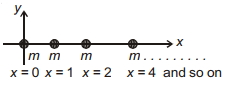
A large number of identical point masses $m$ are placed along $x$-axis, at $x=0,1,2,4$, The magnitude of gravitational force on mass at origin $(x=0)$, will be ............
Which one of the following schematic graphs best represents the variation of $p V$ (in Joules) versus $T$ (in Kelvin) of one mole of an ideal gas? (The dotted line represents $p V=T$ )
Three capacitors of capacitances $6\mu\text{F}$ each are available. The minimum and maximum capacitances, which may be obtained are:

  1. $6\mu\text{F},\ 18\mu\text{F}$

  2. $3\mu\text{F},\ 12\mu\text{F}$

  3. $2\mu\text{F},\ 12\mu\text{F}$

  4. $2\mu\text{F},\ 18\mu\text{F}$

A particle moves in one dimensional field with total mechanical energy $E$ . If potential energy of particle is $V(x)$ , then
A projectile crosses two walls of equal height $H$ symmetrically as shown  The time of flight $T$ is given by  ........ $\sec$
The periodic function $\text{f(t)}=\text{A}\sin(\omega\text{t})$ repeats itself with periodic function of:
As the temperature of a metallic resistor is increased, the product of its resistivity and conductivity:
  1. Increases.
  2. Decreases.
  3. Remains constant.
  4. May increase or decrease.
A steel rod of length 1m and radius 10mm is stretched by a force 100kN along its length. The stress produced in the rod is Ysteel = 2 × 10¹¹Nm-2.
In case of uniform circular motion which of the following physical quantity do not remain constant
Two metallic wires $P$ and $Q$ have same volume and are made up of same material. If their area of cross sections are in the ratio $4: 1$ and force $F_1$ is applied to $\mathrm{P}$, an extension of $\Delta l$ is produced. The force which is required to produce same extension in $Q$ is $\mathrm{F}_2$.The value of $\frac{\mathrm{F}_1}{\mathrm{~F}_2}$ is__________.