MCQ
Gravitational acceleration on the surface of a planet is $\frac{\sqrt 6}{11}g$ , where $g$ is the gravitational acceleration on the surface of the earth. The average mass  density of the planet is $\frac{2}{3}\, times$ that of the earth. If the escape speed on the surface of the earth is taken to be $11\, kms^{-1}$, the escape speed on the surface of  the  planet in $kms^{-1}$ will be
  • A
    $2$
  • $3$
  • C
    $4$
  • D
    $6$

Answer

Correct option: B.
$3$
b
$\mathrm{g}_{\mathrm{p}}=\frac{\mathrm{GM}_{\mathrm{p}}}{\mathrm{R}_{\mathrm{p}}^{2}}=\frac{4}{3} \mathrm{G} \pi \mathrm{R}_{\mathrm{p}} \rho_{\mathrm{p}}$

$\Rightarrow \frac{g_{p}}{g_{e}}=\frac{R_{p} p_{p}}{R_{e} p_{e}}$

Also, $\mathrm{v}_{\mathrm{e}}=\sqrt{2 \mathrm{g} \mathrm{R}}$

$\Rightarrow \frac{\mathrm{v}_{\mathrm{p}}}{\mathrm{v}_{\mathrm{e}}}=\sqrt{\frac{\mathrm{g}_{\mathrm{p}} \mathrm{R}_{\mathrm{p}}}{\mathrm{g}_{\mathrm{e}} \mathrm{R}_{\mathrm{e}}}}=\left(\frac{\mathrm{g}_{\mathrm{p}}}{\mathrm{g}_{\mathrm{e}}}\right) \sqrt{\frac{\rho_{\mathrm{e}}}{\rho_{\mathrm{p}}}}=\frac{\sqrt{6}}{11} \times \sqrt{\frac{3}{2}}$

$\Rightarrow \mathrm{v}_{\mathrm{p}}=3 \mathrm{km} / \mathrm{s}$

Need a full question paper?

Generate a complete, print-ready paper with questions like this in minutes — across 16+ boards, with answer keys.

Start Generating Free

Similar questions

A bullet when fired at a target with a velocity of $100\,\,m/sec$ penetrates one metre into it. If the bullet is fired at a similar target with a thickness $0.5\,\,metre,$  then it will emerge from it with a velocity of
A body falling vertically downwards under gravity breaks in two parts of unequal masses. The centre of mass of the two parts taken together shifts horizontally towards:
rod of $40\, cm$ in length and temperature difference of ${80^o}C$ at its two ends. $A$ nother rod $B$ of length $60\, cm$ and of temperature difference ${90^o}C$, having the same area of cross-section. If the rate of flow of heat is the same, then the ratio of their thermal conductivities will be
A body dropped from the top of a tower clears $7/16^{th}$ of the total height of the tower in its last second of flight. The time taken by the body to reach the ground is........$s$
For a body moving with relativistic speed, if the velocity is doubled, then
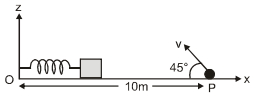
A small block is connected to one end of a massless spring of un-stretched length $4.9 \ m$. The other end of the spring (see the figure) is fixed. The system lies on a horizontal frictionless surface. The block is stretched by $0.2$ $m$ and released from rest at $t =0$. It then executes simple harmonic motion with angular frequency $\omega=\frac{\pi}{3} \ rad / s$.

Simultaneously at $t=0$, a small pebble is projected with speed $v$ from point $P$ at an angle of $45^{\circ}$ as shown in the figure. Point $P$ is at a horizontal distance of $10 \ cm$ from $O$. If the pebble hits the block at $t=1 \ s$, the value of $v$ is (take $g =10 \ m / s ^2$ )

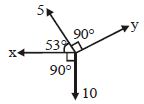
Find the magnitude of the unknown forces $X$ and $Y$ if sum of all forces is zero
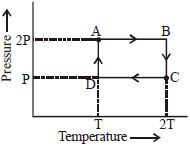
An ideal monoatomic gas is taken through the thermodynamic states $A \to B \to C \to D$ via the paths shown in the figure. If $U_A, U_B, U_C$ and $U_D$ represent the internal energy of the gas in state $A, B\, C$ and $D$ respectively, then which of the following is not true?
A rocket is launched with velocity $10\, km/s$. If radius of earth is $R$, then maximum height attained by it will be
Which of the following velocity-time graphs represent uniform motion