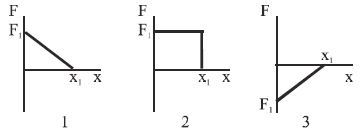
Now work done $=m \times$ potential difference.
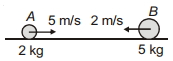
Thus work done for a distance of $4 m$ for a mass $5 k g, W=\frac{4}{20} \times 2 \times 5$
$\Longrightarrow W=2 J$
Generate a complete, print-ready paper with questions like this in minutes — across 16+ boards, with answer keys.
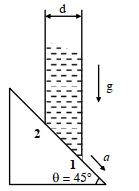
$(A)$ $\beta=0$ when $a= g / \sqrt{2}$
$(B)$ $\beta>0$ when $a= g / \sqrt{2}$
$(C)$ $\beta=\frac{\sqrt{2}-1}{\sqrt{2}}$ when $a= g / 2$
$(D)$ $\beta=\frac{1}{\sqrt{2}}$ when $a= g / 2$

$A.$ The force acting on a planet is inversely proportional to square of distance from sun.
$B.$ Force acting on planet is inversely proportional to product of the masses of the planet and the sun
$C.$ The centripetal force acting on the planet is directed away from the sun.
$D.$ The square of time period of revolution of planet around sun is directly proportional to cube of semi-major axis of elliptical orbit.
Choose the correct answer from the options given below :