MCQ
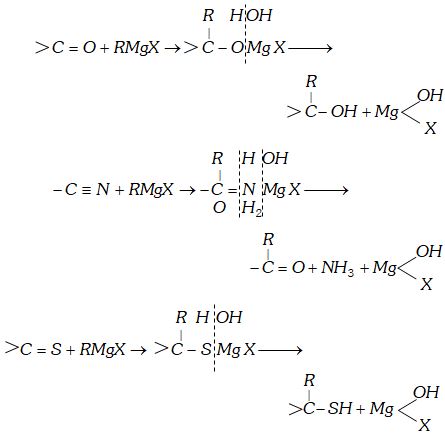
Grignard reagent adds to
  • A
    $ >C = O  $
  • B
    $ - C \equiv N$
  • C
    $  >C = S $
  • All of the above

Answer

Correct option: D.
All of the above
d
(d)Grignard reagent gives addition reactions with compounds containing $C = O,\, - C \equiv N$ and $C = S$ groups.

Need a full question paper?

Generate a complete, print-ready paper with questions like this in minutes — across 16+ boards, with answer keys.

Start Generating Free

Similar questions

Molar conductivity $\left(\Lambda_m\right)$ of aqueous solution of sodium stearate, which behaves as a strong electrolyte, is recorded at varying concentration($c$) of sodium stearate. Which one of the following plots provides the correct representation of micelle formation in the solution?

(Critical micelle concentration ($CMC$) is marked with an arrow in the figures.)

Which of the following enzymes is not useful in the digestion of proteins
Which of the following is the incorrect match for atom of element ?
$A, B$ and $C$ are hydroxy-compounds of the elements $X, Y$ and $Z$ respectively.  $X ,Y$ and $Z$ are in the same period of the periodic table. $A$ gives  an aqueous solution of $pH$ less than seven. $B$ reacts with both strong acids and strong alkalis. $C$ gives an aqueous sohuion which is strongly alkaline.
Which of the following statements is / are true ?

$I :$ The three elements are metals.

$II :$ The electro negativities decrease from $X$ to $Y$ to $Z$.

$III :$ The atomic radius decreases in the order $X, Y$ and $Z.$

$IV : X, Y$ and $Z$ could be phosphorus, aluminium and sodium respectively.
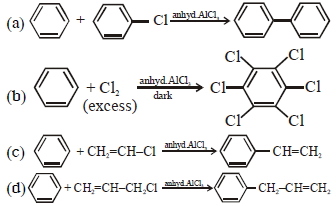
Consider the following reactions is correct
Which of the following diagram show correct change in the ionic character of given compounds according to Fajans rule ?
The rate of certain reaction depends on concentration according to the equation $\frac{{ - dc}}{{dt}}\, = \,\frac{{{K_1}C}}{{1 + {K_2}C}},$ what is the order, when concentration $(c)$ is very-very high
$K_1, K_2$ and $K_3$ are the equilibrium constants of the following reactions $(I), (II)$ and $(III)$, respectively :-
$(I)$ $N_2 + 2O_2  \rightleftharpoons  2NO_2$
$(II)$ $2NO_2  \rightleftharpoons  N_2 + 2O_2$
$(III)$ $NO_2  \rightleftharpoons  \frac{1}{2}N_2 + O_2$
The correct relation from the following is
$[Co(NH_3)_4(NO_2)_2]Cl$ exhibits
Which one does not exhibit paramagnetism