MCQ
${H_2}S$ react with ${O_2}$ to form
- ✓${H_2}O + S$
- B${H_2}O + S{O_2}$
- C${H_2}O + S{O_3}$
- D${H_2}S{O_4} + S$
Generate a complete, print-ready paper with questions like this in minutes — across 16+ boards, with answer keys.
$C{H_2} = C{H_2}\xrightarrow{{HBr}}X\xrightarrow{{{\text{Hydrolysis}}}}Y\mathop {\xrightarrow{{N{a_2}C{O_3}}}}\limits_{{I_2}{\text{ excess}}} Z$
$2 H _2( g )+2 NO ( g ) \rightarrow N _2( g )+2 H _2 O ( g )$
which following the mechanism given below:
$2 NO ( g ) \underset{ k _{-1}}{\stackrel{ k _1}{\rightleftharpoons}} N _2 O _2( g )$
$N _2 O _2( g )+ H _2( g ) \stackrel{ k _2}{\rightleftharpoons} N _2 O ( g )+ H _2 O ( g )$
$N _2 O ( g )+ H _2( g ) \stackrel{ k _3}{\rightleftharpoons} N _2( g )+ H _2 O ( g )$
(fast equilibrium)
(slow reaction)
(fast reaction)
The order of the reaction is
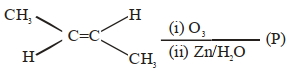
Consider the given reaction. The total number of oxygen atoms present per molecule of the product $(P)$ is___________