MCQ
$H_3BO_3$ is
  • Monobasic and weak Lewis acid
  • B
    Monobasic and weak Bronsted acid
  • C
    Monobasic and strong Lewis acid
  • D
    Tribasic and weak Bronsted acid

Answer

Correct option: A.
Monobasic and weak Lewis acid
a
Central boron atom in $\mathrm{H}_{3} \mathrm{BO}_{3}$ is electron deficient, therefore it accepts a pair of electrons, hence it is weak Lewis acid. There is no d-orbital of suitable energy in boron atom.

So, it can accommodate only one additional electron pair in its outermost shell. Thus, $\mathrm{H}_{3} \mathrm{BO}_{3}$ is monobasic weak Lewis acid.

$\underset{\text { Base }}{\mathrm{H}_{2} \mathrm{O}}$+$\underset{\text { Acid }}{\mathrm{B}(\mathrm{OH})_{3}} \longrightarrow\left[\mathrm{B}(\mathrm{OH})_{4}\right]^{-}+\mathrm{H}^{+}$

Need a full question paper?

Generate a complete, print-ready paper with questions like this in minutes — across 16+ boards, with answer keys.

Start Generating Free

Similar questions

Which of the following may act as an oxidising and reducing agent both?
Calculate the enthalpy change when $50\,ml$ of $0.01\,M$ $Ca(OH)_2$ reacts with $25\,ml$ of $0.01\,M$ $HCl$. Given that $\Delta {H^o}_{{\text{neutralisation}}}$ of strong acid and strong base is $-57.1\,kJ$. [Assuming that $Ca(OH)_2$ is strong base]
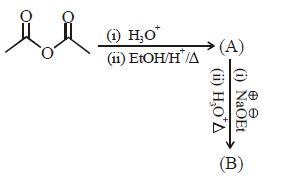
Identify the principal product of the following reaction?
Which of the following acid possesses oxidising, reducing and complex forming properties
The $pH$ of a solution obtained by mixing $50\,\,ml$ of $0.4\,\,N\,\,HCl$ and $50\,\,ml$ of $0.2\,\,N\,\,NaOH$ is
Select correct option
Cannizzaro reaction between formaldehyde molecules involves the formation of
A chemist has $4$ samples of artificial sweetner $A$. $\mathrm{B}, \mathrm{C}$ and $\mathrm{D}$. To identify these samples, he performed certain experiments and noted the following observations :

$(i)$ $A$ and $D$ both form blue-violet colour with ninhydrin.

$(ii)$ Lassaigne extract of $\mathrm{C}$ give  positive $\mathrm{AgNO}_{3}$ test and negative $\mathrm{Fe}_{4}\left[\mathrm{Fe}(\mathrm{CN})_{6}\right]_{3}$ test.

$(iii)$ Lassaigne extract of $\mathrm{B}$ and D gives positive sodium nitroprusside test

Based on these observations which option is correct ?

$A $ will be
Aluminium displaces hydrogen from dilute $HCl$ whereas silver does not. The e.m.f. of a cell prepared by combining $Al/A{l^{3 + }}$ and $Ag/A{g^ + }$ is $ 2.46\,V$  The reduction potential of silver electrode is $ + 0.80\;V$. The reduction potential of aluminium electrode is ........... $\mathrm{V}$