MCQ
Half life period ${t_{1/2}}$ for first order reaction is
- A$K$
- B$\frac{{1.303\,\log \,2}}{K}$
- ✓$\frac{{2.303\,\log \,2}}{K}$
- D$\frac{9}{K}$
Generate a complete, print-ready paper with questions like this in minutes — across 16+ boards, with answer keys.
Assertion $A:$ $3.1500\,g$ of hydrated oxalic acid dissolved in water to make $250.0\,mL$ solution will result in $0.1\,M$ oxalic acid solution.
Reason $R:$ Molar mass of hydrated oxalic acid is $126\,g\,mol ^{-1}$.
In the light of the above statements, chose the correct answer from the options given below:
$A{B_3}(g) \rightleftharpoons A{B_2}(g) + \frac{1}{2}{B_2}(g)$ , when the initial pressure of $AB_3$ is $800\,torr$ and the total pressure developed at equilibrium is $900\,torr$ . What percentage of $AB_3(g)$ is dissociated?
$(A)$ The $M ^{3+} / M ^{2+}$ reduction potential for iron is greater than manganese
$(B)$ The higher oxidation states of first row $d$ block elements get stabilized by oxide ion.
$(C)$ Aqueous solution of $Cr ^{2+}$ can liberate hydrogen from dilute acid.
$(D)$ Magnetic moment of $V ^{2+}$ is observed between $4.4-5.2\,BM$
Choose the correct answer from the options given below:
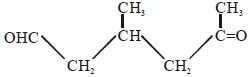
$(A)$ The stronger the temperature dependence of the rate constant, the higher is the activation energy.
$(B)$ If a reaction has zero activation energy, its rate is independent of temperature.
$(C)$ The stronger the temperature dependence of the rate constant, the smaller is the activation energy.
$(D)$ If there is no correlation between the temperature and the rate constant then it means that the reaction has negative activation energy.
Given : $K _{ a }\left( CH _{3} CH _{2} COOH \right)=1.3 \times 10^{-5}$