Question
Hands-on Experiment: Test conductivity using a battery, wire, bulb, and materials like metallic foil, wood, rubber, and record results. Draw circuit diagram and fill observation table.

Answer

self

Need a full question paper?

Generate a complete, print-ready paper with questions like this in minutes — across 16+ boards, with answer keys.
Start Generating Free

Similar questions


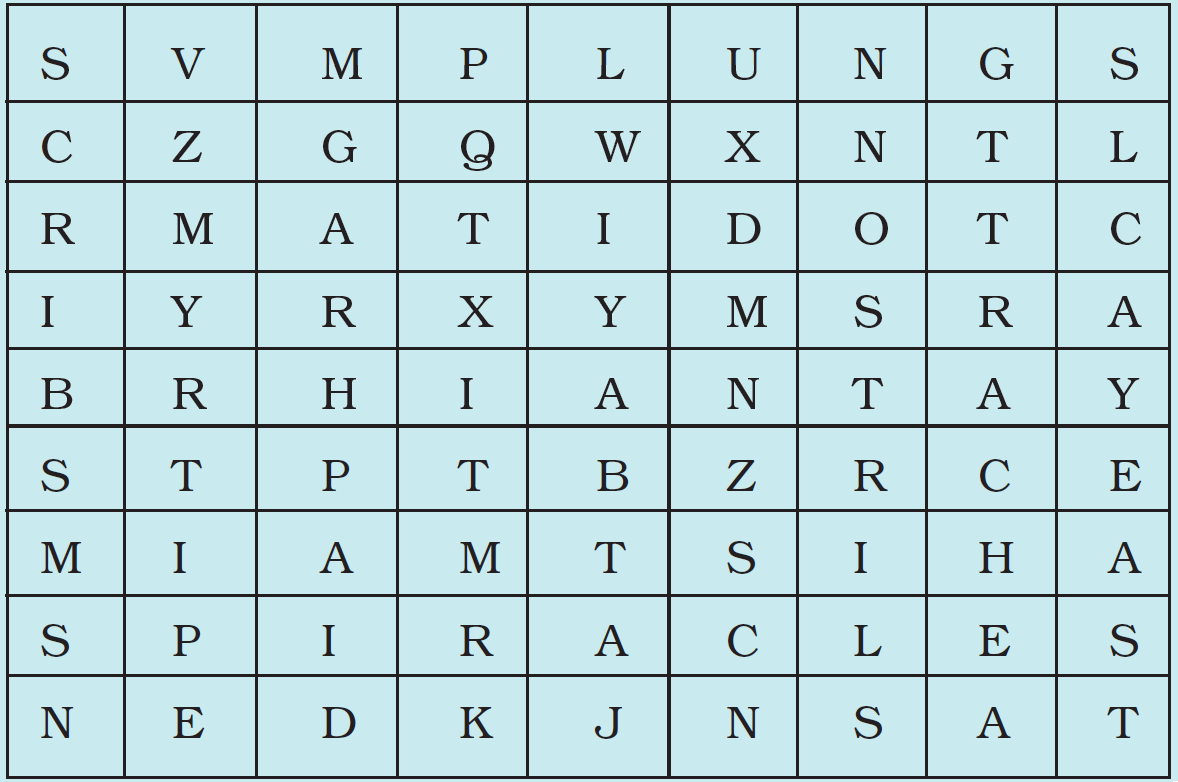
Given below is a square of letters in which are hidden different words related to respiration in organisms. These words may be present in any direction- upwards, downwards, or along the diagonals. Find the words for your respiratory system. Clues about those words are given below the square.


Clues:
  1. The air tubes of insects.
  2. Skeletal structures surrounding chest cavity.
  3. Muscular floor of chest cavity.
  4. Tiny pores on the surface of leaf.
  5. Small openings on the sides of the body of an insect.
  6. The respiratory organs of human beings.
  7. The openings through which we inhale.
  8. An anaerobic organism.
  9. An organism with tracheal system.
Read the passage and answer the questions :
Tanya connects an LED across a battery but it does not glow. She changes the direction and it works.
Q.1. Why did not the LED glow the first time?
(a) Broken battery$\quad$(b) Reverse connection
(c) High voltage$\quad$(d) Weak wire
Q.2. What nature does this show about LED?
(a) Can glow either way$\quad$(b) Needs heat
(c) Works only in one direction
(d) Emits heat
Q.3. Which wire is the positive terminal of the LED?
(a) Longer wire$\quad$(b) Shorter wire
(c) Any wire$\quad$(d) None of these
Dorji has a few bottles of soft drink in his restaurant. But, unfortunately, these are not labelled. He has to serve the drinks on the demand of customers. One customer wants acidic drink, another wants basic and third one wants neutral drink. How will Dorji decide which drink is to be served to whom?
One winter morning, Priya made a cup of hot tea and placed the metal spoon inside it. She held the cup in her hands to feel warm. After a few minutes, she noticed the metal spoon had become hot. Then, she placed the cup on the table near the window where sunlight was coming in. She felt warm standing in the sunlight even without touching anything. Later, she saw the steam rising from the tea and disappearing into the air.
1. Why did the metal spoon become hot?
2. How did Priya feel warm just by standing in the sunlight?
3. What is the process called when hot steam rises from the tea?
From where do the following usually get water? In which form is water present in them?
  1. Clouds.
  2. Plants.
  3. Mountain tops.
  4. Aquifer.
  5. Animals.
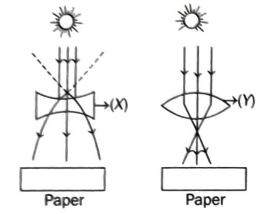
A student is asked to focus sunlight using two different lenses onto a paper.
Image

Observe the image carefully and answer the following questions.
(i) State the name for the shape of lenses X and Y.
(ii) Which of these two lenses can be used to magnify images?
(iii) Explain the changes that happen to the paper kept under both the lenses.
State the factors on which amount of heat produced depends?
Explain the two types of fibres.
Continuously water-logged soils are disadvantageous for plant growth. Why?
Explain a convex mirror. What is the nature of image formed by this mirror$?$