MCQ
He area bounded by $y = x^2, x = y^{2 }$ is:
  • $1$
  • B
    $\frac{1}{6}$
  • C
    $\frac{3}{4}$
  • D
    $\text{None}\text{ of}\text{ these}$

Answer

Correct option: A.
$1$
$=\text{y}=\text{x}^2,\text{y}^2=\text{x}$
$\Rightarrow\text{y}=\sqrt{\text{x}}$
The curves intersect at $(0, 0)$ and $(1,1)$ Area between the curves is given by
$=\int\limits^1_0\sqrt{\text{x}}-\text{x}^2\text{dx}$
$=\frac{1}{2}\text{x}^\frac{3}{2}+\frac{\text{x}^3}{3}\Big|^1_0$
$=\frac{2}{3}+\frac{1}{3}$
$=1$

Need a full question paper?

Generate a complete, print-ready paper with questions like this in minutes — across 16+ boards, with answer keys.
Start Generating Free

Similar questions

$\lim\limits_{\text{n}\rightarrow\infty}\Big\{\frac{1}{2\text{n}+1}+\frac{1}{2\text{n}+2}+\ .....+\frac{1}{2\text{n}+\text{n}}\Big\}$ is equal to:
  1. $\ln\Big(\frac{1}{3}\Big)$
  2. $\ln\Big(\frac{2}{3}\Big)$
  3. $\ln\Big(\frac{3}{2}\Big)$
  4. $\ln\Big(\frac{4}{3}\Big)$
Suppose $X =\left\{x^2, x \in N\right\}$ and $f: N \rightarrow X$ defined such that $f(x)=x^2, x \in N$ then function is:
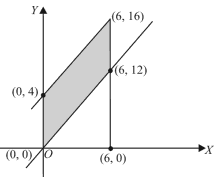
The feasible region for an LPP is shown shaded in the figure. Let $F=3 x-4 y$ be the objective function.
Maximum value of $F$ is
Image
The coordinates of the midpoints of the line segment joining the points (2, 3, 4) and (8, -3, 8) are:
  1. (10, 0, 12)
  2. (5, 6, 0)
  3. (6, 5, 0)
  4. (5, 0, 6)
In a sphere the rate of change of volume is:
  1.  $\pi$ times the rate of change of radius.
  2.  Surface area times the rate of change of diameter.
  3.  Surface area times the rate of change of radius.
  4.  None of these.
Maximize Z = 11 x + 8y subject to $\text{x}\leq4,\text{y}\leq6,\text{x}+\text{y}\leq6,\text{x}\geq0,\text{y}\geq0.$
Choose the correct answer from the given four options.
Two cards are drawn from a well shuffled deck of 52 playing cards with replacement. The probability, that both cards are queens, is:
  1. $\frac{1}{13}\times\frac{1}{13}$
  2. $\frac{1}{13}\times\frac{1}{13}$
  3. $\frac{1}{13}\times\frac{1}{17}$
  4. $\frac{1}{13}\times\frac{4}{15}$
If $\int\frac{1}{(\text{x}+2)(\text{x}^2+1)}\text{ dx}=\text{a}\log|1+\text{x}^2|+\text{b}\tan^{-1}\text{x}+\frac{1}{5}\log|\text{x}+2|+\text{C},$ then
  1. $\text{a}=-\frac{1}{10},\text{ b}=\frac{2}{5}$
  2. $\text{a}=\frac{1}{10},\text{ b}=\frac{2}{5}$
  3. $\text{a}=-\frac{1}{10},\text{ b}=\frac{2}{5}$
  4. $\text{a}=\frac{1}{10},\text{ b}=\frac{2}{5}$
If a line makes angles $\frac{\pi}{4}, \frac{3 \pi}{4}$ with $X -$axis and $Y -$axis respectively, then the angle which it makes with $Z -$axis is
If $\text{f}(\text{x})=\frac{\sin^{-1}\text{x}}{\sqrt{1-\text{x}}^2},$ then $(1-\text{x})^2\text{f}''(\text{x})-\text{xf}(\text{x})=$
  1. 1
  2. -1
  3. 0
  4. None of these