MCQ
he greater reactivity of $F_2$ is due to:
  • A
    Lower electron affinity of $F.$
  • Lower bond energy of $F - F$ bond.
  • C
    Higher electronegativity of $F.$
  • D
    Gaseous state of $F_2$.

Answer

Correct option: B.
Lower bond energy of $F - F$ bond.
The greater reactivity of $F_2$ is due to lower bond energy of $F - F$ bond and bond energy is lower because of charge repulsion between two $F$ atoms $($due to lower size of $F$ atom charge density is high and repulsion is very high so bond energy is low$)$ making its bond enthalpy lower..

Need a full question paper?

Generate a complete, print-ready paper with questions like this in minutes — across 16+ boards, with answer keys.
Start Generating Free

Similar questions

The current in a given wire is $1.8 \,A$. The number of coulombs that flow in $1.36$ minutes will be ............ $\mathrm{C}$
In esterification which of the following is the best combination for maximum rate of reaction
Which reaction of ammonia forms the first step of Ostwald's process?
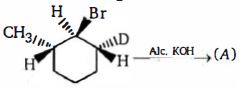
Major product of this reaction is
Upon heating $KClO_3$ in the presence of catalytic amount of $MnO_2$, a gas $W$ is formed. Excess amount of $W$ reacts with white phosphorus to give $X$. The reaction of $X$ with $HNO_3$ gives $Y$ and $Z$.

($1$)  $W$ and $\mathbf{X}$ are, respectively

$[A]$ $O_3$ and $P_4 O_6$   $[B]$ $O_2$ and $P_4 O_6$   $[C]$ $O_2$ and $P_4 O_{10}$    $[D]$ $O_3$ and $P_4 O_{10}$

($2$) $Y$ and $Z$ are, respectively

$[A]$ $N_2 O_3$ and $\mathrm{H}_3 \mathrm{PO}_4$

$[B]$ $N_2 O_5$ and $\mathrm{HPO}_3$

$[C]$ $N_2 O_4$ and $HPO_3$

$[D]$ $N_2 O_4$ and $H_3 PO_3$

Give the answer of quetion ($1$) and ($2$)

Assertion: Electrical conductivity of copper increases with increase in temperature

Reason: The electrical conductivity of metals is due to motion of electrons.

Given below are two statements:

Statement $(I)$ : Fusion of $\mathrm{MnO}_2$ with $\mathrm{KOH}$ and an oxidising agent gives dark green $\mathrm{K}_2 \mathrm{MnO}_4$.

Statement $(II)$ : Manganate ion on electrolytic oxidation in alkaline medium gives permanganate ion.

In the light of the above statements, choose the correct answer from the options given below.
A hypothetical electrochemical cell is shown below $A |A^+ (xM)|| B^+ (yM)| B$ If cell  potential is $+ 0.20\, V$, the cell reaction is :-
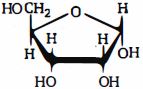
Which of the following represents the anomer of the compound shown ?
Which of the following would have the highest osmotic pressure (assume that all salts are $90\%$ dissociated)