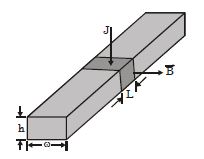
Heart-lung machines and artifical kidney machines employ blood pumps. A mechanical pump can mangle blood cells.Figure represents an electromagnetic pump. The blood is confined to an electrically insulating tube, represented as a rectangle of width $\omega$ and height $h.$ Two electrodes fit into the top and the bottom of the tube. The potential difference between them establishes an electric current through the blood, with current density $J$ over a section of length $L.$ A perpendicular magnetic field exists in the same region. The section of liquid in the magnetic field experiences a pressure increase given by :-
Diffcult
Download our app for free and get started
$\mathrm{P}=\frac{\mathrm{F}}{\mathrm{A}}=\frac{\mathrm{Bih}}{\mathrm{h} \times \omega}$
$\mathrm{i}=\mathrm{J}(\mathrm{L} \times \omega)$
$\Rightarrow \mathrm{P}= \frac{\mathrm{B} \mathrm{JL} \omega \mathrm{h}}{\mathrm{h} \times \omega}$
$\mathrm{P}=\mathrm{BJL}$

Download our appand get started for free
Experience the future of education. Simply download our apps or reach out to us for more information. Let's shape the future of learning together!No signup needed.*
Similar Questions
- 1A particle of specific charge (charge/mass) $\alpha$ starts moving from the origin under the action of an electric field $\vec E = {E_0}\hat i$ and magnetic field $\vec B = {B_0}\hat k$. Its velocity at $(x_0 , y_0 , 0)$ is ($(4\hat i + 3\hat j)$ . The value of $x_0$ is:View Solution
- 2A long solenoid of $50\, cm$ length having $100$ turns carries a current of $2.5$ $A.$ The magnetic field at the centre of the solenold is $...... \times 10^{-5}\;T$View Solution
$\left(\mu_{0}=4 \pi \times 10^{-7}\, T\, m\, A ^{-1}\right)$
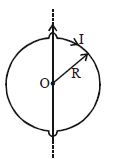
- 3A circular conducting loop of radius $R$ carries a current $I.$ Another straight infinite conductor carrying current $I$ passes through the diameter of this loop as shown in the figure. The magnitude of force exerted by the straight conductor on the loop isView Solution
- 4A moving coil galvanometer of resistance $100 \,\Omega$ is used as an ammeter using a resistance $0.1 \,\Omega$. The maximum deflection current in the galvanometer is $100\,\mu A$. Find the minimum current in the circuit so that the ammeter shows maximum deflection ............... $mA$View Solution
- 5In the previous question, if the current is $i$ and the magnetic field at $D$ has magnitude $B$,View Solution
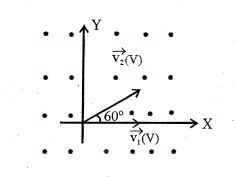
- 6Two charged particles of mass $m$ and charge $q$ each are projected from origin simultaneously with same speed $V$ in transverse magnetic field. If ${\vec r_1}$ and ${\vec r_2}$ are the position vectors of particles (with respect to origin) at $t = \frac{{\pi m}}{{qB}}$ then the value of ${\vec r_1}.{\vec r_2}$ at that time isView Solution
- 7A square loop of side $l$ is kept in a uniform magnetic field $B$ such that its plane makes an angle $\alpha$ with $\vec{B}$. The loop carries a current $i$. The torque experienced by the loop in this position isView Solution
- 8A square loop of edge length $2 \mathrm{~m}$ carrying current of $2 \mathrm{~A}$ is placed with its edges parallel to the $\mathrm{x}-\mathrm{y}$ axis. A magnetic field is passing through the $x-y$ plane and expressed as $\vec{B}=B_0(1+4 x) \hat{k}$, where $\mathrm{B}_0=5 \mathrm{~T}$. The net magnetic force experienced by the loop is. . . . . . . $\mathrm{N}$.View Solution
- 9A steady current $I$ goes through a wire loop $\mathrm{PQR}$ having shape of a right angle triangle with $\mathrm{PQ}=3 x, \mathrm{PR}=4 x$ and $\mathrm{QR}=5 x$. If the magnitude of the magnetic field at $\mathrm{P}$ due to this loop is $k\left(\frac{\mu_0 I}{48 \pi x}\right)$, find the value of $k$.View Solution
- 10A power line lies along the east-west direction and carries a current of $10\, ampere$. The force per metre due to the earth's magnetic field of ${10^{ - 4}}\,tesla$ isView Solution