MCQ
Highest boiling point
  • $CH_3OH$
  • B
    $CH_3Br$
  • C
    $CH_3Cl$
  • D
    $CH_4$

Answer

Correct option: A.
$CH_3OH$
a
Due $O$ to $H-$ bonding

Need a full question paper?

Generate a complete, print-ready paper with questions like this in minutes — across 16+ boards, with answer keys.

Start Generating Free

Similar questions

This reaction,

$\begin{array}{*{20}{c}}
  {\,\,\,\,\,C{H_3}} \\ 
  | \\ 
  {C{H_3} - C - ONa} \\ 
  | \\ 
  {\,\,\,\,\,C{H_3}} 
\end{array}\, + \,C{H_3}C{H_2}Cl\,\xrightarrow{{ - NaCl}}\,$ $\begin{array}{*{20}{c}}
  {C{H_3}\,\,\,\,\,\,\,\,\,\,\,\,\,\,\,\,\,\,\,\,} \\ 
  {\,\,\,|\,\,\,\,\,\,\,\,\,\,\,\,\,\,\,\,\,\,\,\,\,\,\,\,\,\,\,\,\,\,\,} \\ 
  {C{H_3} - C - O - C{H_2} - C{H_3}} \\ 
  {\,|\,\,\,\,\,\,\,\,\,\,\,\,\,\,\,\,\,\,\,\,\,\,\,\,\,\,\,\,\,\,\,} \\ 
  {C{H_3}\,\,\,\,\,\,\,\,\,\,\,\,\,\,\,\,\,\,\,\,\,\,\,} 
\end{array}$

is called
A solution containing $2.5 \times 10^{-3}\, kg$ of a solute dissolved in $75 \times 10^{-3} \,kg$ of water boils at $373.535$ $K$. The molar mass of the solute is $.....\,g\, mol ^{-1}$. [nearest integer] (Given: $K _{ b }\left( H _{2} O \right)=0.52 \,K\, Kg\,mol ^{-1}$, boiling point of water $=373.15 \,K$ )
Nucleic acid is a polymer of
Which of the following compound give at least $1\, mole$ $AgCl$ precipitate with $100\, ml$ of a $10\, M$ solution of $AgNO_3$
The time required to remove electrolytically one fourth of $Ag$ from $0.2\, litre$ of $0.1\,M\, AgCl$ solution by a current of $0.1\,amp$. is approximately .......... $\mathrm{min}$
The quantity of electricity needed to liberate 0.5gram equivalent of an element is:
Butane has a _______ boiling point to that of propanol.
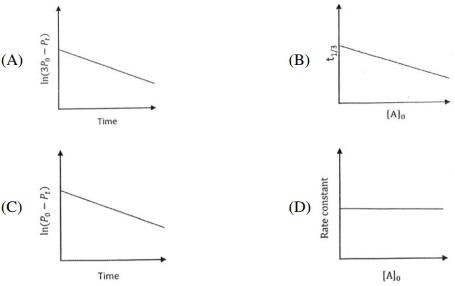
For a first order reaction $A ( g ) \rightarrow 2 B ( g )+ C ( g )$ at constant volume and $300 K$, the total pressure at the beginning $(t=0)$ and at time $t$ are $P_0$ and $P_t$, respectively. Initially, only $A$ is present with concentration $[ A ]_0$, and $t _{1 / 3}$ is the time required for the partial pressure of A to reach $1 / 3^{\text {rd }}$ of its initial value. The correct option(s) is (are) (Assume that all these gases behave as ideal gases)
$\begin{matrix}
   \,\,\,\,\,\,\,Br  \\
   \,\,\,\,|  \\
   C{{H}_{3}}-C{{H}_{2}}-C-C{{H}_{2}}-Et  \\
   \,\,\,\,|  \\
   \,\,\,\,\,\,\,\,\,\,\,\,\,\,\,\,\,\,\,\,\,\,\,\,\,\,\,\,\,\,C{{H}_{2}}(n-\Pr )  \\
\end{matrix}\xrightarrow{alc.\,KOH}\underset{(major)}{\mathop{(A)}}\,$

$n - Pr = n -$ propyl
Product' $(A)$ is

m-chlorobenzaldehyde on treatment with $50 \%$ $\mathrm{KOH}$ solution yields