Question
Highlight the differences between the population interactions given below. Give an example of each.
  1. Parasitism.
  2. Amensalism.
  3. Mutualism.

Answer

  1. Parasitism: Only one species benefits.

Example: Cuscuta/Tape worn.

  1. Amensalism: One species is harmed whereas the other is unaffected.

Example: Penicillium growing on bacterial culture/Trichoderma - biological control agent and plant pathogen.

  1. Mutualism: Both Species benefit.

Example: lichens.

Need a full question paper?

Generate a complete, print-ready paper with questions like this in minutes — across 16+ boards, with answer keys.
Start Generating Free

Similar questions

Why is Agrobacterium tumefaciens a good cloning vector? Explain.
What is natural selection? How is artificial selection different from natural selection? Give one example each from plants and animals where artificial selection has operated.
Answer the following questions:
How do flowers reward their insect pollinators? Explain.
In the majority of angiosperms, the zygote divides by an asymmetric mitotic division and generates two cells. Discuss the fates of these cells.
  1. Name the ancestors of progymnosperm.
  2. Name the ancestors of herbaceous and arborescent lycopod.
  3. Name the ancestors of cycads.
Describe the structure of RNA polynucleotide chain having four different types of nucleotides.
  1. Why did Hershey and Chase use radioactive sulphur and radioactive phosphorus in their experiment?
  2. Write the conclusion they arrived at and how.
Three water samples namely river water, untreated sewage water and secondary effluent discharged from a sewage treatment plant were subjected to BOD test. The samples were labelled A, B and C; but the laboratory attendant did not note which was which. The BOD values of the three samples A, B and C were recorded as 20mg / L 8mg/L and 400mg/L, respectively. Which sample of the water is most polluted? Can you assign the correct label to each assuming the river water is relatively clean?
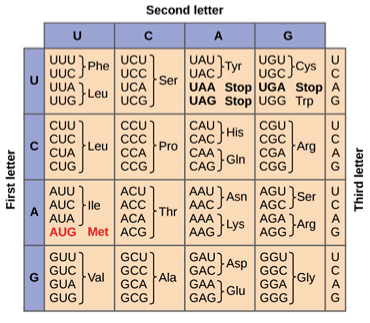
Observe the diagram of Genetic code and answer the following questions:
Image
i. How many codons codes for amino acids and how many do not?
ii. Explain the following giving one example of each.
a. Unambiguous and specific codon
b. Degeneration codon
c. Universal codon
d. Initiator codon
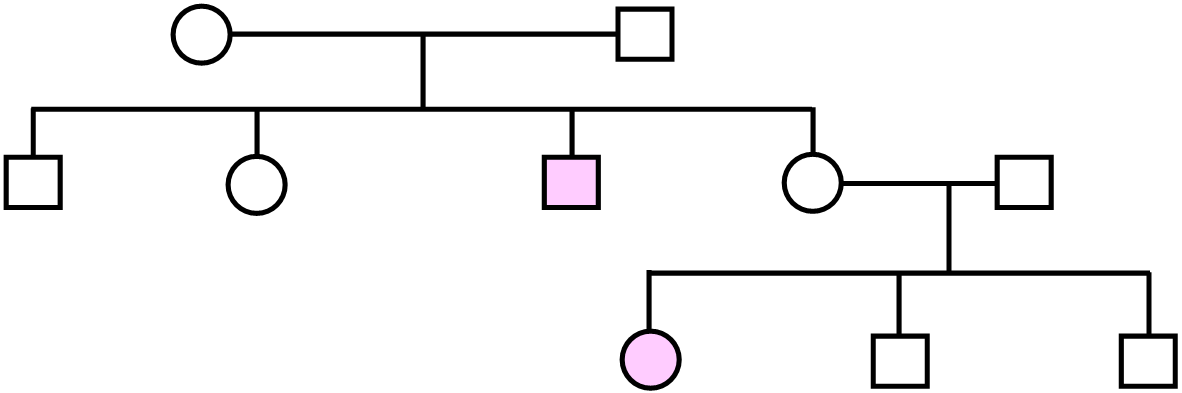
Study the given pedigree chart and answer the questions that follow:

Is the trait recessive or dominant?