MCQ
Holme signal can be given by the using
  • A
    $CaC_2 + CaCN_2$
  • $CaC_2 + Ca_3P_2$
  • C
    $CaC_2 + CaCO_3$
  • D
    $Ca_3P_2 + CaCN_2$

Answer

Correct option: B.
$CaC_2 + Ca_3P_2$
b
$\text{Ca}{{\text{C}}_{2}}+\text{C}{{\text{a}}_{3}}{{\text{P}}_{2}}\xrightarrow{{{H}_{2}}O}$ ${\text{Ca}}{({\text{OH}})_2} + \mathop {\boxed{{{\text{C}}_2}{{\text{H}}_2} + {\text{P}}{{\text{H}}_3}}}\limits^{Signal} $

Need a full question paper?

Generate a complete, print-ready paper with questions like this in minutes — across 16+ boards, with answer keys.

Start Generating Free

Similar questions

A mixture of two moles of carbon monoxide and one mole of oxygen, in a closed vessel is ignited to convert the carbon monoxide to carbon dioxide. If $\Delta H$ is the enthalpy change and $\Delta E$ is the change in internal energy, then
In which of the following molecule electron density on oxygen atom is not correctly mentioned ?
For the reaction$A(g) + 3B(g) \rightleftharpoons 2C(g)$ at $27\,^oC$, $2\, moles$ of $ A$, $4\, moles$ of $B$ and $6\, moles$ of $C$ are present in a $2\, litre$ vessel. If $K_C$ for the reaction is $1.2$, the reaction will proceed in
Which of the following is not an aromatic compound ?
Match the electronic configurations in List-$I$ with appropriate metal complex ions in List-$II$ and choose the correct option.

[Atomic Number: $\mathrm{Fe}=26, \mathrm{Mn}=25, \mathrm{Co}=27$ ]

List-$I$ List-$II$
($P$) $ t_{2 g}^6 e_g^0$ ($1$)$\left[\mathrm{Fe}\left(\mathrm{H}_2 \mathrm{O}\right)_6\right]^{2+}$
($Q$) $t_{2 g}^3 e_g^2$ ($2$) $\left[\mathrm{Mn}\left(\mathrm{H}_2 \mathrm{O}\right)_6\right]^{2+}$
($R$) $e^2 t_2^3$ ($3$)$\left[\mathrm{Co}\left(\mathrm{NH}_3\right)_6\right]^{3+}$
($S$) $t_{2 g}^{+} e_g^2$ ($4$)$\left[\mathrm{FeCl}_4\right]^{-}$
  $\left[\mathrm{CoCl}_4\right]^{2-}$


Atomic number of $ Cr $ and $ Fe$  are $24$  and $26$  respectively. Which of the following is paramagnetic with the spin of electron
Which of the following is not hydrolysed
Oxidation number of sulphur in ${S_2}O_3^{2 - }$is
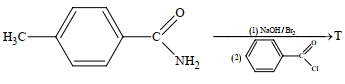
In the reaction $Image$ the structure of the Product $T$ is
The $IUPAC$ name of the following structure is

$[CH_3CH(CH_3)]_2 \,C(CH_2CH_3)C(CH_3) C(CH_2CH_3)_2$