MCQ
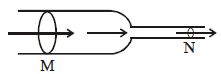
Horizontal tube of non-uniform cross-section has radii of  $0.1\,m$ and  $0.05\,m$ respectively at $M$  and  $N.$  For a stream-line flow of liquid the rate of liquid flow is
  • A
    Continuously changes with time
  • B
    Greater at  $M$  than at $N$
  • C
    Greater at $N$  than at  $M$
  • Same at $M$  and  $N$

Answer

Correct option: D.
Same at $M$  and  $N$
d
According to principle of continuity, for streamline flow of fluid

through a tube of non-uniform cross-section the rate of flow of fluid

(Q) is same at every point in the tube.

$Av =$ constant $\Rightarrow A _{1} v _{1}= A _{2} v _{2}$

Therefore, the rate of flow of fluid is same at $M$ and $N$.

Need a full question paper?

Generate a complete, print-ready paper with questions like this in minutes — across 16+ boards, with answer keys.

Start Generating Free

Similar questions

A motor cycle starts from rest and accelerates along a straight path at $2 \;m / s ^{2}$. At the starting point of the motor cycle there is a stationary electric siren. How far has the motor cycle gone when the driver hears the frequency of the siren at $94 \%$ of its value when the motor cycle was at rest?

(Speed of sound $=330 ms ^{-1}$)

At $NTP$ water boils at $100°C.$ Deep down the mine, water will boil at a temperature
In which form, the energy is stored in a fuel?
A cylinder of mass $M$ and radius $R$ rolls on an inclined plane. The gain in kinetic energy is
A motor-car tyre has a pressure of $2\, atm$ at $27\,^oC$. It suddenly burst's. If $\left( {\frac{{{C_p}}}{{{C_v}}}} \right) = 1.4$ for air, find the resulting temperatures (Given $4^{1/7} = 1.219$)
A refrigerator consumes an average $35\, {W}$ power to operate between temperature $-10^{\circ} {C}$ to $25^{\circ} {C}$. If there is no loss of energy then how much average heat per second does it transfer? (in ${J} / {s}$)
A particle in $SHM $ is described by the displacement equation $x(t) = A\cos (\omega t + \theta ).$ If the initial $(t = 0)$ position of the particle is $1 \,cm$ and its initial velocity is $\pi $cm/s, what is its amplitude? The angular frequency of the particle is $\pi {s^{ - 1}}$
$A$ pulley is hinged at the centre and a massless thread is wrapped around it. The thread is pulled with a constant force $F$ starting from rest. As the time increases,
A thin rod of mass $0.9\, kg$ and length $1 \,m$ is suspended, at rest, from one end so that it can freely oscillate in the vertical plane. A particle of move $0.1\, kg$ moving in a straight line with velocity $80\,m / s$ hits the rod at its bottom most point and sticks to it (see figure). The angular speed (in $rad/s$) of the rod immediately after the collision will be
Which of the sets given below may represent the magnitudes of three vectors adding to zero?