Question
How are different aromatic compounds synthesized by benzene diazonium chloride? Explain with examples.
Answer

SELF

Need a full question paper?

Generate a complete, print-ready paper with questions like this in minutes — across 16+ boards, with answer keys.

Start Generating Free

Similar questions

Describe the physical and chemical properties of potassium permanganate.
  1. Complete the following chemical equations:
  1. $ \text{MnO}_{4}^{-}\text{(aq)}+\text{S}_{2}\text{O}_{4}\text{(aq)}+\text{H}_{2}\text{O}\text{(l)}\rightarrow$
  2. $\text{Cr}_{2}\text{O}_{4}^{2-}\text{(aq)}+\text{Fe}^{2+}\text{(aq)}+\text{H}^{+}\text{(aq)}\rightarrow$
  1. Explain the following observations:
  1. $La^{3+} (Z = 57)$ and $Lu^{3+} (Z = 71)$ do not show any colour in solutions.
  2. Among the divalent cations in the first series of transition elements, manganese exhibits the maximum paramagnetism.
  3. $Cu^+$ ion is not known in aqueous solutions.
  1. Account for the following:
  1. $BiH_3$ is the strongest reducing agent in Group $15$ elements hydrides.
  2. $Cl_2​​​​​​​$​​​​​​​ acts as a bleaching agent.
  3. Noble gases have very low boiling points.
  1. Draw the structures of the following:
  1. $H_4P_2O_7$
  2. $XeOF_4$​​​​​​​
Explain the acidic property of carboxylic acid and dicuss the effect of substituents on their acidity.
State the reactions and reaction conditions for the following conversions:
i. Benzene diazonium chloride to nitrobenzene.
ii. Aniline to benzene diazonium chloride.
iii. Ethylamine to methylamine.
The decomposition of a hydrocarbon follows the equation.$\text{k}=(4.5\times10^{11}\text{s}^{-1})\text{e}^{-28000}\text{ K/T}$
Calculate Ea.
  1. What may be the possible oxidation states of the transition metals with the following d electronic configurations in the ground state of their atoms:
$3d^34s^2, 3d^54s^2 $and $3d^6 4s^3$^. Indicate relative stability of oxidation states in each case.
  1. Write steps involved in the preparation of (i) $Na_2CrO_4 $from chromite ore and (ii) K_2MnO_4 from pyrolusite ore.
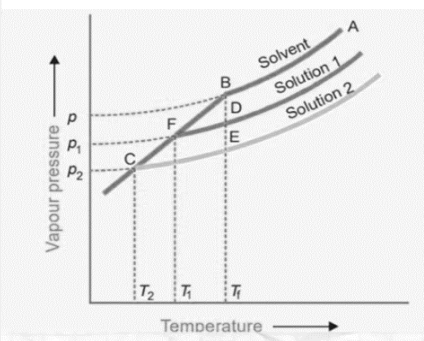
$(a).$ An experiment was carried out in the laboratory, to study depression in freezing point. $1 \ M$ aqueous solution of $Al(NO_3)_3$ and $1 \ M$ aqueous solution of glucose were taken. From the given figure identify solution $1.$ and solution $2.$ Give a plausible reason for your answer
Image
$(b).$ The osmotic pressure of a solution of cane sugar was found to be $2.46 \ atm$ at $300 \ K.$ If the solution was diluted five times, calculate the osmotic pressure at the same temperature.
How can the osmotic pressure of the given cane sugar solution be decreased without changing its volume? Give a reason for your answer.
On heating lead (II) nitrate gives a brown gas “A”. The gas “A” on cooling changes to colourless solid “B”. Solid “B” on heating with NO changes to a blue solid ‘C’. Identify ‘A’, ‘B’ and ‘C’ and also write reactions involved and draw the structures of ‘B’ and ‘C’.
  1. Draw the molecular structures of the following compounds:
  1. $N_2O_5$.
  2. $XeOF_4$.
  1. Explain the following observations:
  1. Sulphur has a greater tendency for catenation than oxygen.
  2. ICl is more reactive than $I_2$.
  3. Despite lower value of its electron gain enthalpy with negative sign, fluorine $(F_2)$ is a stronger oxidising agent than $Cl_2$​​​​​​​.