Question
How are EM waves produced?

Answer

  1. According to quantum theory, an electron, while orbiting around the nucleus in a stable orbit does not emit EM radiation even though it undergoes acceleration.
  2. It will emit an EM radiation only when it falls from an orbit of higher energy to one of lower energy.
  3. EM waves (such as X-rays) are produced when fast moving electrons hit a target of high atomic number (such as molybdenum, copper, etc.).
  4. An electric charge at rest has an electric field in the region around it but has no magnetic field.
  5. When the charge moves, it produces both electric and magnetic fields.
  6. If the charge moves with a constant velocity, the magnetic field will not change with time and hence, it cannot produce an EM wave.
  7. But if the charge is accelerated, both the magnetic and electric fields change with space and time and an EM wave is produced.
  8. Thus, an oscillating charge emits an EM wave which has the same frequency as that of the oscillation of the charge.

Need a full question paper?

Generate a complete, print-ready paper with questions like this in minutes — across 16+ boards, with answer keys.
Start Generating Free

Similar questions

Discuss characteristics of scalar product of two vectors.
Define mean solar day. Explain the method for measurement of time.
What is super conductivity?
Explain why the Earth doesn't appear to move even though the object of mass $m \  \ ( m << M )$ kept on the Earth exerts equal and opposite gravitational force on it.
A monochromatic ray of light is incident at $37^\circ $ on an equilateral prism of refractive index $3/2$. Determine angle of emergence and angle of deviation. If angle of prism is adjustable, what should its value be for emergent ray to be just possible for the same angle of incidence.
Discuss the vector form of gravitational force between two masses with the help of diagram.
Refractive index of a flint glass varies from $1.60$ to $1.66$ for visible range. Radii of curvature of a thin convex lens are $10\ cm$ and $15\ cm.$ Calculate the chromatic aberration between extreme colours.
What are derived quantities and derived units? State two examples. State the corresponding S.L. and C.G.S. units of the examples.
A particle of mass $12 \ kg$ is acted upon by a force $f = (100 – 2x^2)$ where f is in newton and $‘x \ ’$ is in metre. Calculate the work done by this force in moving the particle $x = 0$ to $x = -10 m.$ What will be the speed at $x = 10 m$ if it starts from rest?
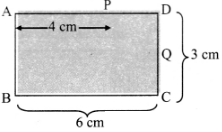
Figure below shows the section ABCD of a transparent slab. There is a tiny green LED light source at the bottom left corner B. A certain ray of light from B suffers total internal reflection at nearest point P on the surface AD and strikes the surface CD at point Question Determine refractive index of the material of the slab and distance DQ. At Q, the ray PQ will suffer partial or total internal reflection?
Image