Question
  1. How are Mendelian inheritance, polygenic inheritance and pleiotropy different from each other?
  2. Explain polygenic inheritance pattern with the help of a suitable example.

Answer


  1. Pleiotropy: A single gene that has an effect on the expression of two or more phonotypic traits is said to have a pleiotropic effect on the traits. For example, testosterone controls the development of what are referred to as secondary sexual characteristics (e.g., a hon’s mane), but testosterone also relates  behavioral traits like aggraession/Thus, a gene that controls the level of testosterone would have a pleiotropic iffect on the expression of many secondary sexual traitjs which are morphological, as well as behavioral. The concept of pleiotropy is intimately related to the concept of trade-off (Steams- 1976). Pleiotropy describes the proximate genetic gene controls the expression of two or more traits and those traits are related to a fitness trade-off, then we have identified the proximate source of the trade-off.

Polygenic: If two or more genes are responsible for a single trait, the phenotypic. 

  1. If the gene for eye color is on the X chromosome, the red eyed male in the second cross will pass his red eyed X to only his daughters, who in turn received only a recessive white- carrying X from their mother. Thus all females had trend eyes like their father. Since the male fruit fly passes only the Y to his sons, their eye color is determined entirely by the single X chromosome they receive from their mother (in this case white). Thus all the males in the second cross were white eyed.

These experiments introduced the concept of sex-linkage, the occurrence of genes on that part of the X that lack a corresponding location on the Y. Sex- linked recessives (such as white eyes in fruit flies, hemophilia, baldness, and colorblindness in humans) occur more commonly in males, since there is no chance of them being heterozygous. Such condition is termedhemizygous.

Need a full question paper?

Generate a complete, print-ready paper with questions like this in minutes — across 16+ boards, with answer keys.

Start Generating Free

Similar questions

List the attributes that populations but not individuals possess.
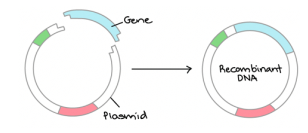
A vector is a way to take a sequence of DNA, usually, and introduce it into another place. So what vectors do is allow you to propagate the DNA you're interested in, in the organism you've chosen to propagate it in. So the simplest one is the origins of recombinant DNA technology: They made copies of RNAs, and they were able to insert these into what is known as plasmids.
Image
Unless the vector and source DNA are cut, fragments separated and joined, the desired recombinant vector molecule cannot be created.
i. How are the desirable DNA sequences cut?
ii. Explain the technique used to separate the cut fragments.
iii. How are the resultant fragments joined to the vector DNA molecule?
Write the full name of the word AIDS. By what name is the virus that causes this disease known? Explain the symptoms and prevention measures of AIDS disease. Draw a labelled diagram of the replication of the AIDS virus.
How bacterial cells are made competent to take up DNA?
Name the modern technology of crop improvement. How is it beneficial in crop improvement? Explain. ###Write an essay on tissue culture.
The following is the illustration of the sequence of ovarian events (a-i) in a human female.

Name the ovarian hormone and the pituitary hormone that have caused the above mentioned event.

  1. Represent diagrammatically three kinds of age-pyramids for human populations.
  2. How does an age pyramid for human population at given point of time helps the policymakers in planning for future?
Write about multiple allelism with suitable example.###Describe multiple albinism showing the inheritance pattern of blood groups in human beings.
Species diversity decreases as we move away from the equator towards the poles. What could be the possible reasons?
Which type of food would have lactic acid bacteria. Discuss their useful application.