Question
  1. How are Mendelian inheritance, polygenic inheritance and pleiotropy different from each other?
  2. Explain polygenic inheritance pattern with the help of a suitable example.

Answer

 
  1. Pleiotropy: A single gene that has an effect on the expression of two or more phonotypic traits is said to have a pleiotropic effect on the traits. For example, testosterone controls the development of what are referred to as secondary sexual characteristics (e.g., a hon’s mane), but testosterone also relates behavioral traits like aggraession/Thus, a gene that controls the level of testosterone would have a pleiotropic iffect on the expression of many secondary sexual traitjs which are morphological, as well as behavioral. The concept of pleiotropy is intimately related to the concept of trade-off (Steams- 1976). Pleiotropy describes the proximate genetic gene controls the expression of two or more traits and those traits are related to a fitness trade-off, then we have identified the proximate source of the trade-off.
Polygenic: If two or more genes are responsible for a single trait, the phenotypic.
  1. If the gene for eye color is on the X chromosome, the red eyed male in the second cross will pass his red eyed X to only his daughters, who in turn received only a recessive white- carrying X from their mother. Thus all females had trend eyes like their father. Since the male fruit fly passes only the Y to his sons, their eye color is determined entirely by the single X chromosome they receive from their mother (in this case white). Thus all the males in the second cross were white eyed.
These experiments introduced the concept of sex-linkage, the occurrence of genes on that part of the X that lack a corresponding location on the Y. Sex- linked recessives (such as white eyes in fruit flies, hemophilia, baldness, and colorblindness in humans) occur more commonly in males, since there is no chance of them being heterozygous. Such condition is termedhemizygous.

Need a full question paper?

Generate a complete, print-ready paper with questions like this in minutes — across 16+ boards, with answer keys.
Start Generating Free

Similar questions

What do you understand by connecting link? Explain with examples.
What do you understand by Parturition? Discuss the parturition and lactation process in human.
Mukta visits a dairy farm near her locality to buy milk for her household. While, waiting there for her turn, she noticed that one of the member of the farm was injecting something into the cow before milking. She was very curious and discussed her queries with her friend (a biology expert).
  1. What did the injection contain?
  2. Why is this injection administered to the cow?
  3. State any two methods of herd impre vement.
  4. What values are shown by Mukta?
a. Draw the embryo sac of a flowering plant and label the following:
i. Central cell
ii. Chalazal end
iii. Synergids
b. Name the cell and explain the process it undergoes to develop into an embryo sac.
c. Explain the development of endosperm in coconut.
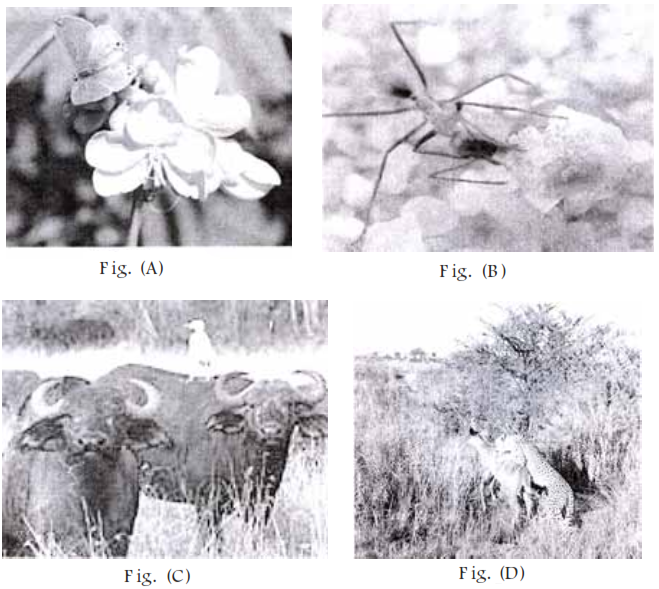
Observe the set of 4 figures A, B, C and D and, answer the following questions,
  1. Which one of the figures shows mutualism?
  2. What kind of association is shown in D?
  3. Name the organisms and the association in C.
  4. What role is the insect performing in B?
​​​​​​​
What are recombinant DNA vaccines? Give two examples of such vaccines. Discuss their advantages.
Answer the following questions:
At which stage of life does gametogenesis begin in human male and female respectively?
Describe the model of phosphorus cycle in the terrestrial ecosystem.
A true breeding pea plant homozygous for axial violet flowers is crossed with another pea plant with terminal white flowers (aavv).
What would be the phenotype and genotype of $F_1$ and $F_2$ generations?
Write the scientific name of the bacteria that causes pneumonia. What happens in this disease? What are its symptoms?