Maharashtra BoardEnglish MediumSTD 12 SciencePhysicsAC Circuits4 Marks
Question
How are oscillations produced using an inductor and a capacitor?
✓
Answer
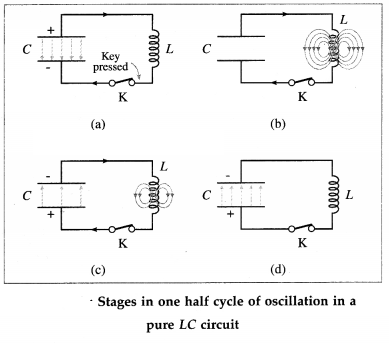
Consider a charged capacitor of capacitance $C_r$ with an initial charge $q_0$ connected to an ideal inductor of inductance $L$ through a key $K$. We assume that the circuit does not include any resistance or a source of emf. At first, the energy stored in the electric field in the dielectric medium between the plates of the capacitor is $U _{ E }=\frac{1}{2} \frac{q_0^2}{C^{\prime}}$, while the energy stored in the magnetic field in the inductor is zero. When the key is closed, the capacitor begins to discharge through the inductor and there is a clockwise current in the circuit, as shown in below figure (a). Let $q$ and $i$ are the instantaneous values of charge on the capacitor and current in the circuit, respectively. As $q$ decreases, $i$ increases $: i=-d q / d t$. Thus, the energy $U_B=\frac{1}{2} L_i^2$ stored in the magnetic field of the inductor increases from zero. Since the circuit is free of resistance, energy is not dissipated in the form of heat, so that the decrease in the energy stored in the capacitor appears as the increase in energy stored in the inductor. As the current reaches its maximum value i(y the capacitor is fully discharged and all the energy is stored in the inductor, from figure (b). Although $q =0$ at this instant, $dq / dt$ is nonzero. The current in the inductor then continues to transfer charge from the top plate of the capacitor to its bottom plate, as in from figure (c). The electric field in the capacitor builds up again, but now in the opposite sense, as energy flows back into it from the inductor. Eventually, all the energy of the magnetic field of the inductor is transferred back into the electric field of the capacitor, which is now fully charged, from figure (d). The capacitor then begins to discharge with an anticlockwise current until the energy is completely back with the inductor. The magnetic field in the inductor is in the opposite sense and becomes maximum when the current reaches its maximum minimum value $- i _0$. Subsequently, the current in the inductor charges the capacitor once again until the capacitor is fully charged and back to its original condition. In the absence of an energy dissipative resistance (ideal condition), this cycle continues indefinitely. When the magnitude of the current is maximum, the energy is stored completely in the magnetic field. When the energy is stored entirely in the electric field, the current is zero. The current varies sinusoidally with time between $i_0$ and $-i_0$. The frequency of this electrical oscillation in the $L C$ circuit is determined by the values of $L$ and $C$. [Notes : (1) Electrical oscillations in an LC circuit are analogous to the oscillations of an ideal mechanical oscillator. An LC circuit with resistance is analogous to a damped mechanical oscillator, while one with a source of alternating emf is analogous to a forced mechanical oscillator. (2) With suitable choices of $L$ and $C$, it is possible to obtain frequencies ranging from $10 Hz$ to $10 GHz$. (3) In practice, LC oscillations are damped because an inductor has some resistance $( R )$ and hence Joule heat (izRt) is developed in it. The amplitude of oscillations goes on decreasing with time and becomes zero eventually. Also, part of energy stored in the inductor and capacitor is radiated in the form of electromagnetic waves. Working of radio and TV transmitters is based on such radiation.]
Need a full question paper?
Generate a complete, print-ready paper with questions like this in minutes — across 16+ boards, with answer keys.