Question
How are polymers classified on the basis of mode of polymerization?###Write the classification of polymers based on mode of polymerization.

Answer

There are three modes of polymerization depending upon the types of reactions taking place between the monomers.
  1. Addition polymerization (or chain growth polymerization)
  2. Condensation polymerization (or step growth polymerization)
  3. Ring opening polymerization
  4. Addition polymerization or chain growth polymerization : It is a process of polymers by the repeated addition of a large number of monomers is called addition polymerization (like alkenes) without loss of any small molecules.
    Example : Formation of polyethylene from ethylene is well known example of addition polymerization. It is a chain growth polymerization.
  5. Condensation polymerization or step growth polymerization : The process of formation of polymers from polyfunctional monomers with the elimination of some small molecules such as water, hydrochloric acid, methanol, ammonia is called condensation polymerization.
    Image
    Example : The formation of terylene, a polyester polymer, from ethylene glycol and terephthalic acid. Condensation polymerization is a step growth polymerization.
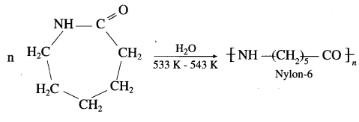
  6. Ring opening polymerization : The process of formation of polymers from cyclic compounds (like lactams, cyclic ethers, etc.) by ring opening is called ring opening polymerization.
    Example : Polymerization of e-caprolactam.
    ImageRing opening polymerization proceeds by addition of a single monomer unit to the growing chain molecules. It is a step growth polymerization.

Need a full question paper?

Generate a complete, print-ready paper with questions like this in minutes — across 16+ boards, with answer keys.
Start Generating Free

Similar questions

Write balanced equations for the half reactions and calculate the reduction potentials at $25^{\circ} C$ for the following half cells :
$(a) \ Cl ^{-}(1.2 M ) \mid Cl _2( g , 3.6 atm ) E ^0=1.36 V$
$(b) \ Fe ^{2+}(2 M ) \mid Fe _{( s )} E ^0=-0.44 V$

Image

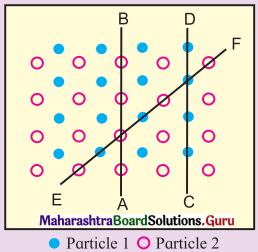
Observe the above figure carefully. The two types of circles in this figure represent two types of constituent particles of a solid.

Question 1.
Will you call the arrangement of particles in this solid regular or irregular ?

Question 2.
Is the arrangement of constituent particles in directions $\overrightarrow{ A B }, \overrightarrow{ C D }$ $\overrightarrow{ E F }$ same or different?

Write four' uses of hydrochloric acid.
Write chemical formula of the following oxoacids of chlorine:
$(a)$ Hypochlorous acid $(b)$ chlorous acid $(c)$ chloric acid $(d)$ perchloric acid.
Which of the four colligative properties is most often used for molecular mass determination? Why?
Which of the following solutions will have maximum boiling point elevation and which have minimum freezing point depression assuming the complete dissociation? (a) $0.1\ m\ KCl$ (b) $0.05\ m\ NaCl$ (c) $1\ m\ AlPO_4$ (d) $0.1\ m\ MgSO_4.$
How are following compounds prepared by hydrolysis of alkyl halides
(1) Ethanol
(2) Isopropyl alcohol
(3) tert-butyl alcohol
(4) methyl alcohol
(5) butan-2-ol?
What is abnormal colligative property? Explain the reasons.
What happens when chlorine reacts with?

Na

What is the relationship between molar solubility and solubility product for salts given below : $(i) Ag_2CrO_4 (ii) Ca_3(PO_4)_2 (iii) Cr(OH)_3.$
Explain the structure of sucrose.