Question
How are seasons caused?

Answer

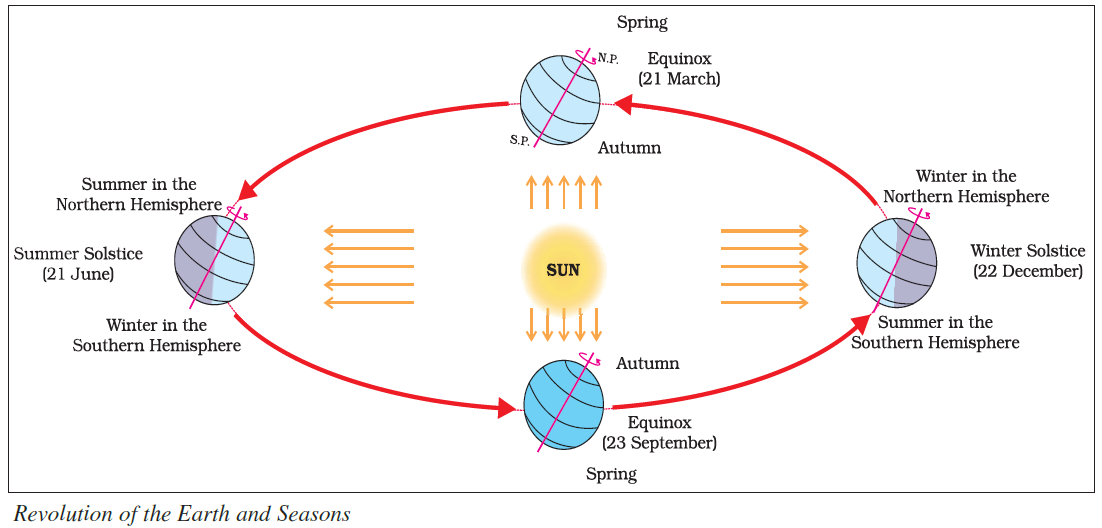
  1. The Earth revolves round the Sun on an elliptical orbit.
  2. Its axis is inclined in the same direction (east) on its orbit by 2314°.
  3. The revolution of the Earth and the inclination of the earth’s axis in a fixed direction cause seasons.
  4. A year is divided into four seasons.
  5. They are Spring, Summer, Autumn and Winter.
  6. Seasons change with the change in the position of the Earth around the Sun.
On 21st June, Northern hemisphere is tilted towards the Sun.
  1. On that day the Sun shines directly on the Tropic of Cancer $(23\frac{1}{2^\circ}) \text{N}$ Hence, these areas receive more heat.
  2. The areas near the poles receive less heat because the rays of the Sun are slanting there.
  3. The North hemisphere is inclined towards the Sun and the places beyond the Arctic Circle experience continuous day light.
  4. As a large portion of the Northern hemisphere gets light from the Sun, therefore, it is Summer in the Northern hemisphere.
  5. The duration of day is longer and that of night shorter here.
At this time in the Southern hemisphere all these conditions are opposite.
  1. It is winter season there.
  2. Nights are longer than days.
  3. This position of the Earth is called summer solstice.
On 22nd December, the Tropic of Capricorn receives the direct rays of the Sun and Southern hemisphere tilts towards it.
  1. On this day the Sun shines vertically on the Tropic of Capricorn (23W S).
  2. Hence a larger portion of the Southern Hemisphere gets light.
  3. It is summer in the Southern hemisphere with longer days and shorter nights.
  4. The opposite conditions are prevalent in the Northern hemisphere.
  5. This position of the Earth is called winter solstice.
On 21 March and 23 September, The Sun shines vertically on the equator.
  1. In this position neither of the hemispheres is tilted towards the Sun, so the whole of the Earth experiences equal days and equal nights.
  2. It is neither very cold nor very hot all over the world.
  3. The Northern hemisphere experiences spring on 21st March and autumn on 23rd September.
  4. Exactly the opposite happens in the Southern hemisphere. Here, it is spring on September 23rd and autumn on March 21st.
  5. These positions are called Spring and Autumn Equinoxes respectively.

Need a full question paper?

Generate a complete, print-ready paper with questions like this in minutes — across 16+ boards, with answer keys.
Start Generating Free