Question
How can phenol be converted to aspirin?
Answer

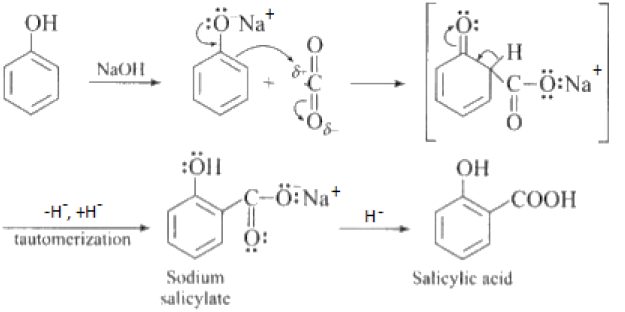
Phenol is converted into salicylic acid. The reaction is usually carried out by allowing sodium phenoxide to absorb carbon dioxide and then heating the product to $400 K$ and $4-7 \ atm$ pressure. The first unstable intermediate is formed which undergoes a proton shift to form sodium salicylate. The subsequent acidification of sodium salicylate gives.
Image
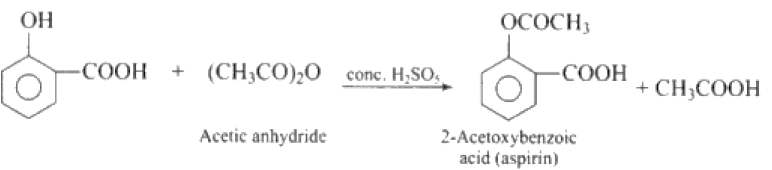
Then aspirin is obtained by acetylating salicylic acid with acetic anhydride and conc. $H_2SO_4$Image
The preparation of Aspirin from salicylic acid is an example of an electrophilic substitution reaction in which carbon dioxide is an electrophile.

Need a full question paper?

Generate a complete, print-ready paper with questions like this in minutes — across 16+ boards, with answer keys.

Start Generating Free

Similar questions

The rate constant for the decomposition of ethyl iodide
$C_2H_5l(g) → C_2H_4(g)+Hl(g)$
at $600K$ is $1.60 \times 10^{-5} s^{-1}$. Its energy of activation is $209kJ/mol$. Calculate the rate constant of the reaction at $700K$.
Calculate the molarity of 250 mL solution made by dissolving 5 g NaOH in water.
Define the following:
  1. Cationic detergents
  2. Narrow spectrum antibiotics
  3. Disinfectants
What is the difference between Galvanic cell (Electrochemical cell) and Electrolytic cell.
  1. Using valence bond theory, predict the shape and magnetic character of
$[Ni(CO)_4]. [Ni = 28].$
  1. Give one example of application of coordination compounds-in medicine.
Discuss chemical properties of lanthanoids.
Why vitamin D, E and K compounds are essential for us? Describe their important sources.
The following results have been obtained during the kinetic studies of the reaction.
$2A + BC → D$
Experiment $[A]/mol \ L-1$ $[B]/mol \ L-1$ Initial rate of formation of $D/mol \ L-1 \ min-1$
$I$ $0.1$ $0.1$ $6.0 \times 10^{-3}$
$II$ $0.3$ $0.2$ $7.2 \times 10^{-2}$
$III$ $0.3$ $0.4$ $2.88 \times 10^{-1}$
$IV$ $0.4$ $0.1$ $2.40 \times 10^{-2}$
Determine the rate law and the rate constant for the reaction.
How would you account for the following:
  1. Among lanthanoids, Ln (III) compounds are predominant. However, occasionally in solutions or in solid compounds, $+2$ and $+4$ ions are also obtained.
  2. The $E^o_{M^{2+}/M}$ for copper is positive $(0.34V)$. Copper is the only metal in the first series of transition elements showing this behaviour.
  3. The metallic radii of the third $(5d)$ series of transition metals are nearly the same as those of the corresponding members of the second series.
Describe the following types of colloids, giving an example for each:
  1. Multimolecular colloids.
  2. Macromolecular colloids.