Question
How did de – Broglie conclude the modification of Bohr’s II postulate?

Answer

  1. De – Broglie concluded that wavelengths of matter waves can be quantized.
Explanation:
de – Broglie concluded his modification of Bohr’s second postulate by stating that the wavelengths of matter waves can be quantized.
This implies that the electrons can exist in those orbits which had a complete set of several wavelengths.

Need a full question paper?

Generate a complete, print-ready paper with questions like this in minutes — across 16+ boards, with answer keys.
Start Generating Free

Similar questions

A ray of monochromatic light is incident on one refracting face of a prism of angle $75^\circ $. It passes through the prism and is incident on the other face at the critical angle. If the refractive index of the material of the prism is $\sqrt{2}$, the angle of incidence on the first face of the prism is
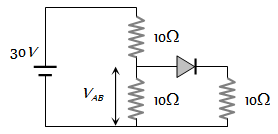
Find $V_{AB}$
A short magnet oscillates with a time period 0.1 s at a place where horizontal magnetic field is 24μT. A downward current of 18 A is established in a vertical wire 20 cm east of the magnet. The new time period of oscillator(a) 0.1 s(b) 0.089 s(c) 0.076 s(d) 0.057 s
       
An electromagnetic wave, going through vacuum is described by $\text{E}=\text{E}_0\sin(\text{kx}-\omega\text{t}.)$ Which of the following is independent of wavelength?
The hysteresis cycle curve for the material of a permanent magnet is:
The difference between the sum of the masses of the constituent particles and the mass of an atom is called $...... $.
Two coherent sources of intensities, $I _1$ and $I _2$ produce an interference pattern. The maximum intensity in the interference pattern will be
If the intensity of incident radiation in a photo-cell is increased, how does the stopping potential vary?
A generator has an e.m.f. of $440$ volt and internal resistance of $400$ ohm. Its terminals are connected to a load of $4000$ ohm. The voltage across the load is:
Work function of lithium and copper are respectively $2.3\ eV$ and $4.0\ eV$. Which one of the metal will be useful for the photoelectric cell working with visible light ? $(h = 6.6 \times 10^{–34} J-s, c = 3 \times 10^8 m/s)$