Maharashtra BoardEnglish MediumSTD 12 ScienceBIOLOGYMolecular Basis of Inheritance5 Marks
Question
How did Meselson and Stahl experimentally prove that DNA replication is semiconservative? Explain.
✓
Answer
It was to show that DNA replication is semiconservative.
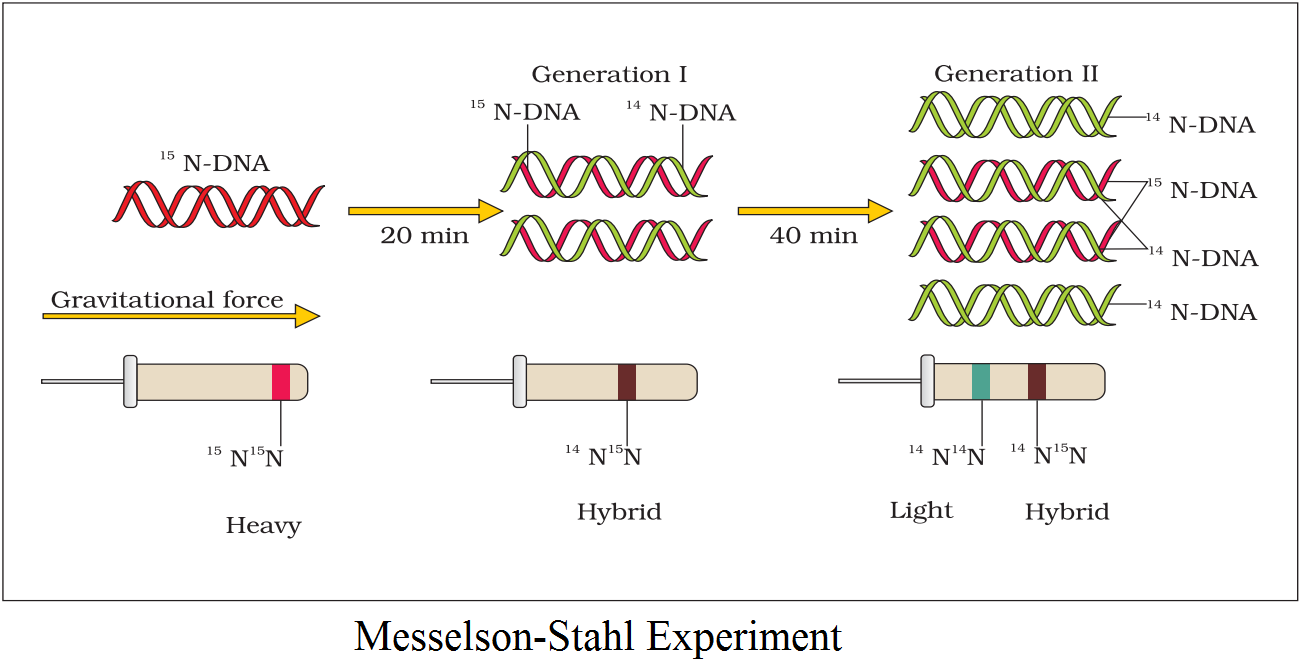
After completion of replication, each new/ daughter molecule of DNA has one parental strand and one newly synthesised strand; this is called semiconservative replication of DNA. Experiment:
i. Mathew Meselson and Franklin Stahl performed the experiment.
ii. They grew E.coli, in a medium containing ${ }^{15} NH _4 Cl$, until ${ }^{15} N$ was incorporated in the two strands of newly formed E.coli cells; this 'heavy' DNA can be separated from the normal ${ }^{14} N$-DNA by centrifugation in cesium chloride (CsCl) density gradient.
iii. Then they transferred the cells into a medium with normal ${ }^{14} NH _4 Cl$ and took out samples at various time intervals.
iv. They extracted the DNA and centrifuged it to measure the densities.
v. The DNA extracted from cells after one generation after transfer from the ${ }^{15} N$ medium to ${ }^{14} N$ medium (i.e. after about 20 minutes), had an intermediate/ hybrid density.
vi. The DNA extracted after two generations (ie. after 40 minutes) consisted of equal amounts of 'light' DNA and 'hybrid' DNA.
vii. This proves that after replication, each DNA molecule has one parental strand and one newly-synthesised strand, i.e. replication is semiconservative.
Need a full question paper?
Generate a complete, print-ready paper with questions like this in minutes — across 16+ boards, with answer keys.