Question
How do antiseptics differ from disinfectants? Give one example of each.

Answer

Antiseptics are the chemicals which either kill or prevent the growth of micro-organisms without affecting the living human tissues. Disinfectants also kill the micro-organism and also affect the living human tissues. For example :
(i) Antiseptic : Dettol, iodoform, tincture iodine.
(ii) Disinfectants: Chlorine, potassium permanganate.

Need a full question paper?

Generate a complete, print-ready paper with questions like this in minutes — across 16+ boards, with answer keys.
Start Generating Free

Similar questions

Answer the following:
(a) What is the order of photochemical reaction?(b) For the homogeneous decomposition of $N _2 O _5$ into $NO _2$ and $O _2 ; 2 N_2 O _5(g) \rightarrow 4 N O_2(g)+O_2(g)$ Rate $= k \left[ N _2 O _5\right]$
Find out the order of reaction with respect to $N _2 O _5$.
Define the following as related to protein :
Denaturation
At absolute zero, an exothermic reaction is always spontaneous but at temperatures above absolute zero, we have to consider both enthalpy and entropy before we can predict spontaneity. Why?
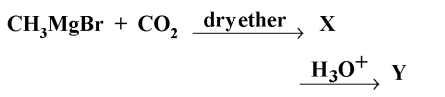
Image
In the above reaction sequence, write the chemical formula and name of X and Y.
(i) Name the product obtained when excess of ethanol is treated with ammonia in the presence of Alumina?
(ii) How is methyl amine prepared from the following compounds? Give the equation.
(a) $CH _3- MgCl$
(b) $CH _3 COCl$
What is a mineral? How does it differ from an ore ?###Differentiate between mineral and ore.
Give reasons for the following observations:
Haloarenes are less reactive than haloalkanes towards nucleophillic substitution reaction.
What is called electrochemical equivalent (Z)?
How is the concept of coupling reactions useful in explaining the occurrence of non spontaneous thermochemical reactions? Explain giving an example.
Match the items of Column I and Column II
  Column I   Column II
(i) SN1 reaction (a) vic-dibromides
(ii) Chemicals in fire extinguisher (b) gem-dihalides
(iii) Bromination of alkenes (c) Racemisation
(iv) Alkylidene halides (d) Saytzeff rule
(v) Elimination of HX from alkylhalide (e) Chlorobromocarbons