Question
How do industries cause water pollution?

Answer

Industries cause water pollution in the following ways:
$-$Industries such as oil refineries, paper factories, textile and sugar mills and chemical factories discharge harmful chemicals into rivers and streams. These chemicals include arsenic, lead and flourides which are very toxic to plants and animals.
$-$The soil is also affected by impure water which causes changes in acidity of soil and affects the growth of worms and plants etc.
$-$Some industries and power plants releases hot water into the rivers. Hot water can also be considered as a pollutant. It raises the temperature of the water body and adversely affects the plants and animals living in it.

Need a full question paper?

Generate a complete, print-ready paper with questions like this in minutes — across 16+ boards, with answer keys.

Start Generating Free

Similar questions

Write a paragraph in your own words on each of the following. Weeding.
Explain food preservatives with examples.
The part of $P$ and $Q$ are present only in plant cells, and they are not present in animal cells. The part $P$ contains a green pigment called $R$ whereas part $Q$ is made of a tough material $S$. The part $P$ takes part in the food making process whereas part $Q$ gives shape and support to the plant cell.
$a.$ What is $(i) P$, and $(ii) Q?$
$b.$ What is $(i) R$, and $(ii) S?$
Write a paragraph in your own words on each of the following. Preparation of soil.
Aanandi took two test tubes and marked them A and B. She put two spoonfuls of sugar solution in each of the test tubes. In test tube B, she added a spoonful of yeast. Then she attached two incompletely inflated balloons to the mouth of each test tube. She kept the setup in a warm place, away from sunlight.
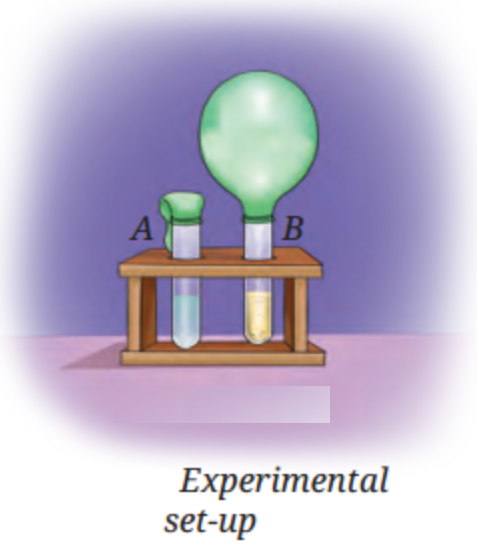
Image
(i) What do you predict will happen after 3-4 days? She observed that the balloon attached to test tube B was inflated. What can be a possible explanation for this?
(a) Water evaporated in test tube B and filled the balloon with the water vapour.
(b) The warm atmosphere expanded the air inside test tube B, which inflated the balloon.
(c) Yeast produced a gas inside test tube B, which inflated the balloon.
(d) Sugar reacted with warm air, which produced gas, eventually inflating the balloon.
(ii) She took another test tube, 1/4 filled with lime water. She removed the balloon from test tube B in such a manner that the gas inside the balloon did not escape. She attached the balloon to the test tube with lime water and shook it well. What do you think she wants to find out?
At many places the wastewater containing human excreta from homes and carried in big underground pipes is dumped into a river as such which pollutes the river water.
$a.$ What is the common name of such wastewater?
$b.$ Name five types of harmful organisms contained in it.
$c.$ Name any five human diseases caused by drinking river water contaminated with such wastewater.
A glass rod is rubbed with a silk cloth and an inflated rubber balloon is rubbed with a woollen cloth. Now, out of glass rod, silk cloth, rubber balloon and woollen cloth:
$i.$ which two objects acquire negative charge?
$ii.$ which two objects acquire positive charge?
What is global warming? Name the gas whose increasing percentage in air is leading to global warming. State a harmful effect which can be caused by global warming.
What are the major products $($or fractions$)$ of petroleum refining? Give one use of each petroleum product.