Question
How do metals differ from non-metals in :
(i) ion formation
(ii) electronic configuration
(iii) chemical nature of their oxides?

Answer

(i) Metals form positively charged ions, whereas non-metals form negatively charged ions.
(ii) Metals have 1 to 3 electrons in their valence shells, whereas non-metals have 4 to 7 electrons in their valence shells.
(iii) The oxides of metals are basic in nature, whereas oxides of non-metals are acidic or neutral in nature.

Need a full question paper?

Generate a complete, print-ready paper with questions like this in minutes — across 16+ boards, with answer keys.
Start Generating Free

Similar questions

Calculate the mass of iron in 10 kg of iron ore which contains 80% of pure ferric oxide.
Give two balanced reactions of each type to show the following properties of sulphuric acid:
Non-volatile nature
Choose the most appropriate answer from $( SO_2 , SiO_2 , Al_2O3 , CO , MgO , Na_2O )$
(a) A covalent oxide of a metalloid.
(b) An oxide which when dissolved in water form acid .
(c) A basic oxide
(d) An amphoteric oxide.
How will you obtain the following from dil. HCl acid? Give equations.
(i) hydrogen (ii) carbon dioxide (iii) sulphur dioxide
(a) (i) Which period in the Periodic Table is the shortest?
(ii) Name all the elements present in this period.
(b) (i) Which period in the Periodic Table is the longest and complete?
(ii) How many elements are present in it?
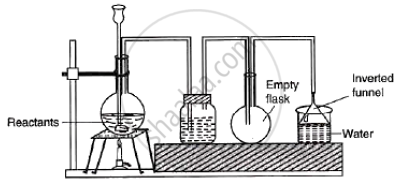
The given set up in the figure is for the preparation of an acid.

(a) Name the acid prepared by this method.
(b) name the reactants used.
(c) why empty flask is used
(d) what is the drying agent used? Why is this drying agent chosen?
(e) what is the role of the inverted funnel in the arrangement
Give a chemical test to distinguish between of ethane and ethene ?
Write the reactions of $SO_2$​​​​​​​ and oxides of nitrogen which leads to acid rain formation.
Solution A is a strong acid
Solution B is a weak acid
Solution C is a strong alkali
(i) Which solution contains solute molecules in addition to water molecules?
(ii) Which solution will give a gelatinous white precipitate with zinc sulphate solution? The precipitate disappears when an excess of the solution is added.
(iii) Which solution could be a solution of glacial acetic acid?
(iv) Give an example of a solution which is a weak alkali.
The gases chlorine, nitrogen, ammonia and sulphur dioxide are collected under the same conditions of temperature and pressure. The following table gives the volumes of gases collected and the number of molecules (x) in 20 litres of nitrogen. You are to complete the table giving the number of molecules in the other gases in terms of x.
GasVolume (in litres)Number of molecules
Chlorine Nitrogen Ammonia Sulphur dioxide10 20 20 5x