Question
How do things work?

Answer

Things work because of how different parts or materials interact with each other. For example, in a clock, the gears move to show the time, and in a plant, the roots absorb water to help it grow, glowing of an electric bulb. Our bodies work in a similar way, with each organ having a special role to keep us healthy. Science helps us understand how these parts work together to make things function properly.
Need a full question paper?

Generate a complete, print-ready paper with questions like this in minutes — across 16+ boards, with answer keys.

Start Generating Free

Similar questions

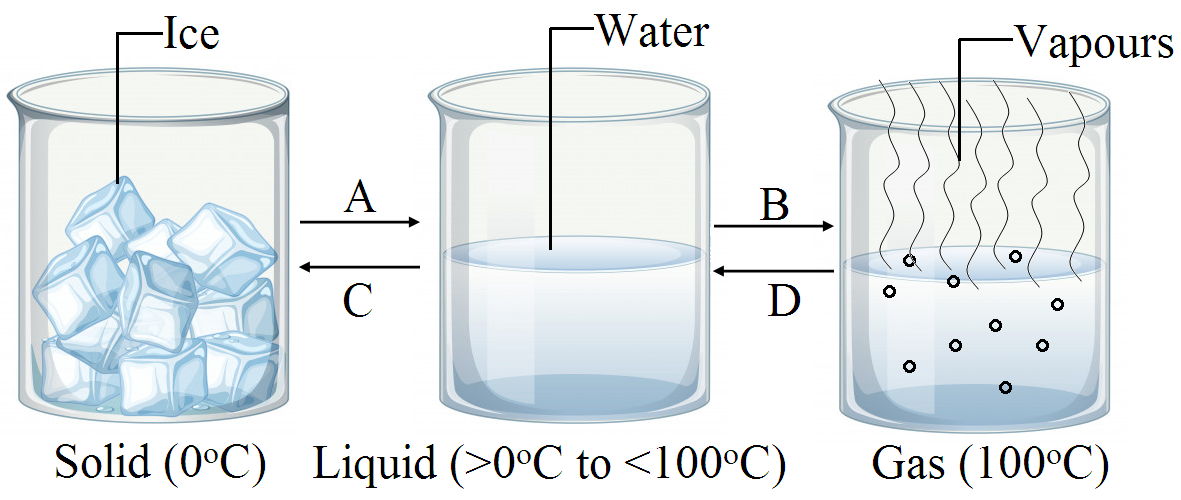
Given below are three states of water in a beaker. These states are inter-convertible. Name the process forward and backforth labelled $A, B, C, D,$ which cause these conversions.
Consider the following statements
(i) Both acids and bases change colour of all indicators.
(ii) If an indicator gives a colour change with an acid, it does not give a change with a base.
(iii) If an indicator changes colour with a base, it does not change colour with an acid.
(iv) Change of colour with an acid and a base depends on the type of the indicator.
Which of the above statements is/are correct?
(a) Only (iv)
(b) (i) and (iv)
(c) (ii) (iii) and (iv)
(d) All of the above
Why is chlorophyll important for the production of starch in plants?
Magnesium ribbon burns in air and changes to white substance, i.e. magnesium oxide. When magnesium oxide dissolves in water, what type of change take place? Give reason in support of your answer. Express the change in the form of equation.
How is a convection current formed in water?
Why do plants store food as starch instead of glucose?
Explain how the seasons would be affected if the Earth’s axis were not tilted.
The Moon is much smaller than the Sun, yet it can block the Sun completely from our view during a total solar eclipse. Why is it possible?
Think and suggest some ways to minimise waste and pollutants at their source, taking your home as an example.
Give reasons for each of the following.
(i) We should not throw used tea leaves into sink.
(ii) We should not throw cooking oil and fats down the drain.