Question
How does a fluid differ from a solid?

Answer

In response to a shear as well as normal force, a solid deforms and develops a restoring force. Within the elastic limit, both types of deformation is reversible. A solid changes its shape under a shear. A normal force causes a change in its length or volume. If the elastic limit is exceeded, the solid gets an irreversible deformation called a permanent set.
A fluid, on the other hand, can only be subjected to normal compressive stress, called pressure. A fluid does not have a definite shape, so that under a shear it begins to flow, Real fluids, with non-zero viscosity, display a weak resistance to shear.
Need a full question paper?

Generate a complete, print-ready paper with questions like this in minutes — across 16+ boards, with answer keys.

Start Generating Free

Similar questions

The total energy of free surface of a liquid drop is \(2 \pi\) times the surface tension of the liquid. What is the diameter of the drop? (Assume all terms in SI unit).
In Young's double$-$slit experiment, interference fringes are observed on a screen $1 m$ away from the two slits which are $2\ mm$ apart. A point $P$ on the screen is $1.8\ mm$ from the central bright fringe,
$(i)$ Find the path difference at $P$.
$(ii)$ If the wavelength of the light used in $4800 A$, what can you say about the illumination at $p?$
What is the advantage of a radial magnetic field in a moving-coil galvanometer and how is it produced?
Calculate the wavelength of \(H _\gamma\) line and series limit for Brackett series.
Obtain an expression for magnetic induction along the axis of toroid on the basis of Ampere's circuital law.
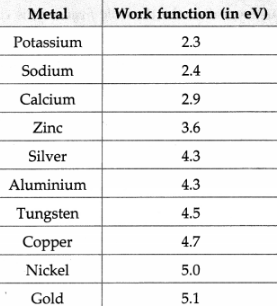
Using the values of work function given in Table $14.1$, tell which metal will require the highest frequency of incident radiation to generate photocurrent.

Image
Wavelengths of two notes in the air are \(\left(\frac{70}{153}\right) m\) and \(\left(\frac{70}{157}\right) m\). Each of these notes produces 8 beats per secon with a tuning fork of fixed frequency. Find the velocity of sound in the air and frequency of the tuning fork.
If a glass plate of refractive index $1.732$ is to be used as a polarizer, what would be the
$(i)$ polarizing angle and
$(ii)$ angle of refraction?
Name two materials that have small and positive magnetic susceptibility.
In a periodic table the average atomic mass of magnesium is given as $24.312\ u$. The average value is based on their relative natural abundance on earth. The three isotopes and their masses are ${ }_{12}^{24} Mg\  (23.98504\ u),$ ${ }_{12}^{25} Mg\  (24.98584\ u)$ and ${ }_{12}^{26} Mg\ (25.98259\ u).$ The natural abundance of ${ }_{12}^{24} Mg$ is $78.99 \%$ by mass. Calculate the abundances of other two isotopes.