Question
How does an unpolarised light get polarised when passed through a polaroid?
Two polaroids are set in crossed positions. A third polaroid is placed between the two making an angle $\theta $ with the pass axis of the first polaroid. Write the expression for the intensity of light transmitted from the second polaroid. In what orientations will the transmitted intensity be $(i)$ minimum and $(ii)$ maximum?
Answer

A polaroid consists of long chain molecules aligned in a particular direction. The electric vectors (associated with the propagating light wave) along the direction of the aligned molecules get absorbed. Thus, if an unpolarised light wave is incident on such a polaroid, then the light wave will get linearly polarised with the electric vector oscillating along a direction perpendicular to the aligned molecules.
Expression for the intensity transmitted through second Polaroid:
$\text{l} = \text{(I}_{0}\cos^{2}\theta)\cos^{2}(90^{0} - \theta) = \text{I}_{0}(\cos\theta\sin\theta)^{2} = \text{I}_{0}\sin^{2}2 \theta/ 4 $
Where $I_0$​​​​​​​ is the intensity of the polarized light after passing through the first polaroid.
Intensity will be maximum when $\theta = 45^\circ $ and minimum when $\theta = 0^\circ $

Need a full question paper?

Generate a complete, print-ready paper with questions like this in minutes — across 16+ boards, with answer keys.

Start Generating Free

Similar questions

If both the number of protons and number of neutrons are conserved in each nuclear reaction, in what way is mass converted into energy (or vice-versa) in a nuclear reaction?
A pole of length 1.00m stands half dipped in a swimming pool with water level 50.0 cm higher than the bed. The refractive index of water is 1.33 and sunlight is coming at an angle of 45° with the vertical. Find the length of the shadow of the pole on the bed.
Suppose an attractive nuclear force acts between two protons which may be written as $\text{F}=\text{Ce}^{-\text{kr}}/\text{r}^2.$
  1. Write down the dimensional formulae and appropriate $SI$ units of $C$ and $k.$
  2. Suppose that $k = 1 fermi^{-1}$ and that the repulsive electric force between the protons is just balanced by the attractive nuclear force when the separation is $5$ fermi. Find the value of $C.$
In an experiment on photoelectric effect, the slope of the cut-off voltages versus frequency of incident light is found to be $4.12 \times 10^{-15}$ V s. Calculate the value of Planck's constant.
Estimate the proportion of boron impurity whieh will increase the conductivity of a pure silicon sample by a factor of $100$. Assume that each boron atom creates a hole and the concentration of holes in pure silicon at the same temperature is $7 \times 10^{15}$ holes per cubic metre. Density of silicon is $5 \times 10^{21}$ atoms per cubic metre.
The sound level at a point 5.0m away from a point source is 40dB. What will be the level at a point 50m away from the source?
A charge of $20\mu\text{C}$ is placed on the positive plate of an isolated parallel-plate capacitor of capacitance $10\mu\text{F}.$ Calculate the potential difference developed between the plates.
If one of the two electrons of a $H_2$ molecule is removed, we get a hydrogen molecular ion $\text{H}^+_2​.$ In the ground state of an $\text{H}^+_2​,$ the two protons are separated by roughly $1.5 \mathring A ,$ and the electron is roughly $1 \mathring A$ from each proton. Determine the potential energy of the system. Specify your choice of the zero of potential energy.
  1. Draw a ray diagram showing the formation of image by a reflecting telescope.
  2. Write two advantages of a reflecting telescope over a refracting telescope.
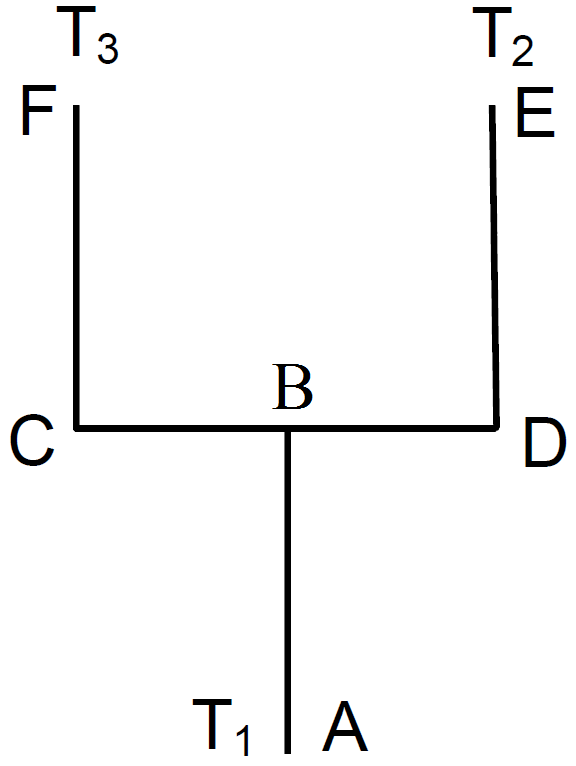
Four identical rods $AB, CD, CF$ and $DE$ are joined as shown in figure. The length, cross$-$sectional area and thermal conductivity of each rod are $l, A$ and $K$ respectively. The ends $A, E$ and $F$ are maintained at temperatures $T_1, T_2$ and $T_3$ respectively. Assuming no loss of heat to the atmosphere, find the temperature at $B.$​​​​​​​